





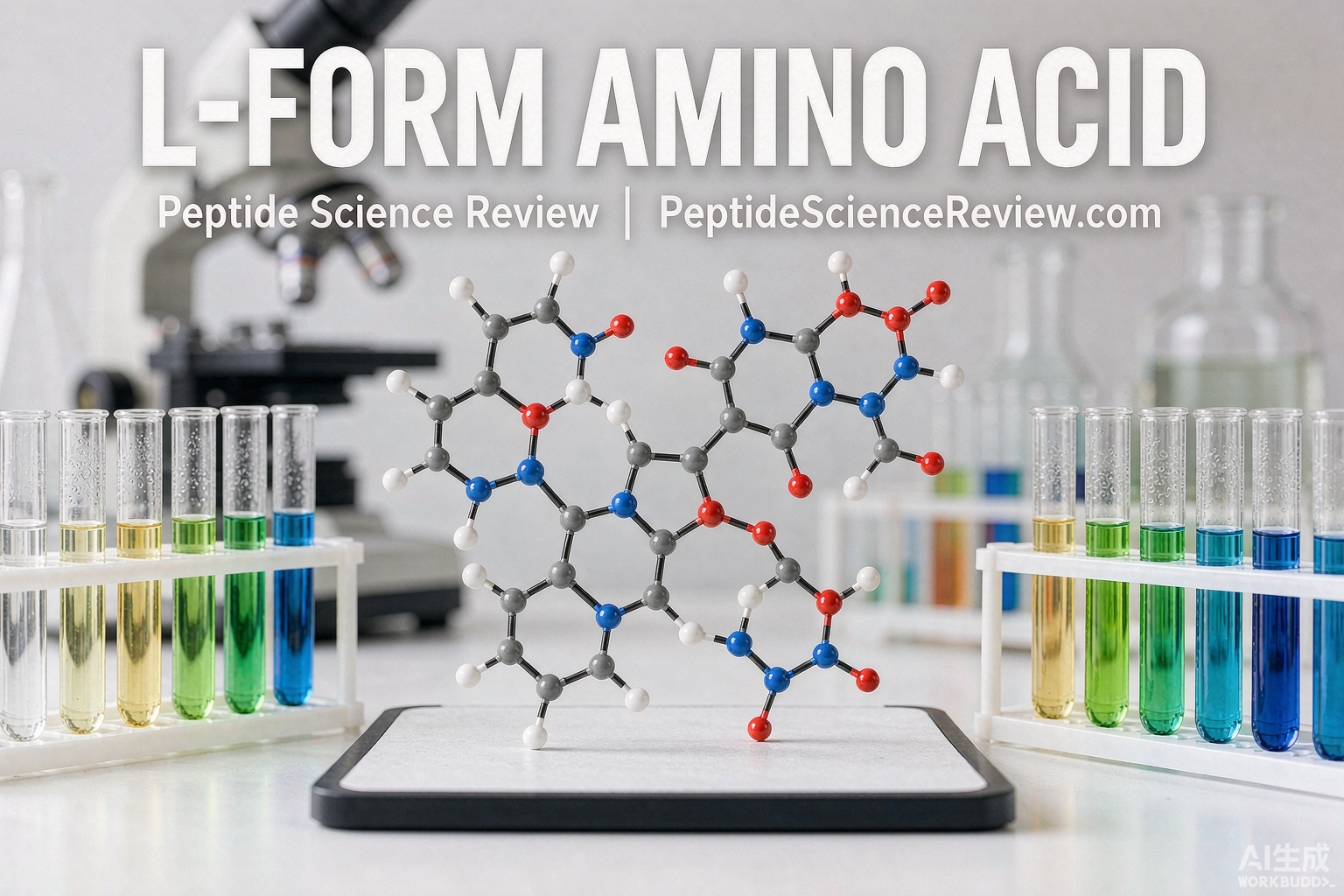
What does the L-form of amino acids mean?
The explanation of the L-form of amino acids you provided is accurate and aligns with the previous response I gave. To ensure clarity and avoid redundancy, I’ll summarize and confirm the key points in English, as requested, while addressing any potential nuances:
What does the L-form of amino acids mean?
The L-form (L-configuration) of an amino acid refers to its chiral configuration. Amino acids are the building blocks of proteins, and most (except glycine) have a chiral center at their α-carbon atom, leading to two mirror-image isomers: L-type (Levo, left) and D-type (Dextro, right).
Detailed Explanation:
1. Chirality and Configuration:
– The α-carbon of an amino acid is bonded to four distinct groups: an amino group (-NH₂), a carboxyl group (-COOH), a hydrogen atom (-H), and a side chain (-R). This creates a chiral center, resulting in two stereoisomers.
– The L- and D-configurations are defined based on the spatial arrangement of these groups, specifically using the Fischer projection. In the L-configuration, the amino group (-NH₂) appears on the left side of the projection, while in the D-configuration, it is on the right.
2. Biological Significance:
– In nature, nearly all organisms (including humans) use L-amino acids exclusively for protein synthesis. This is a result of evolutionary selection, making L-amino acids dominant in biological systems.
– D-amino acids are rare in nature but can be found in certain bacterial cell walls (e.g., peptidoglycan) or antibiotics.
3. Origin of Naming:
– The terms “L” and “D” come from the Latin levo (left) and dextro (right), originally based on the optical activity (rotation of polarized light). However, modern definitions rely on molecular configuration rather than optical rotation, as the latter does not always correlate directly with configuration.
4. Importance of L-Configuration:
– The structure and function of proteins depend heavily on the L-configuration of amino acids. Enzymes, receptors, and other biomolecules typically recognize only L-amino acids, and D-amino acids are generally not incorporated into proteins.
– In pharmaceuticals and nutritional supplements, L-amino acids (e.g., L-lysine, L-glutamine) are used because they are compatible with human biology.
5. Examples:
– L-Glutamic Acid: Commonly found in foods, a key component of monosodium glutamate (MSG), and widely present in proteins.
– D-Glutamic Acid: Less common in humans, but may appear in certain bacteria or specialized metabolic pathways.
Summary:
The L-form refers to the specific stereochemical configuration of amino acids that is predominant in biological systems, critical for protein synthesis and compatible with life processes. If you have additional questions or need further clarification (e.g., specific applications in seaweed extracts or other contexts), feel free to ask!
Interested in JINGFENG’s amino acid products? Explore our full range of high-quality biostimulants and organic fertilizers.





Leave a Comment
Your email address will not be published. Required fields are marked *