





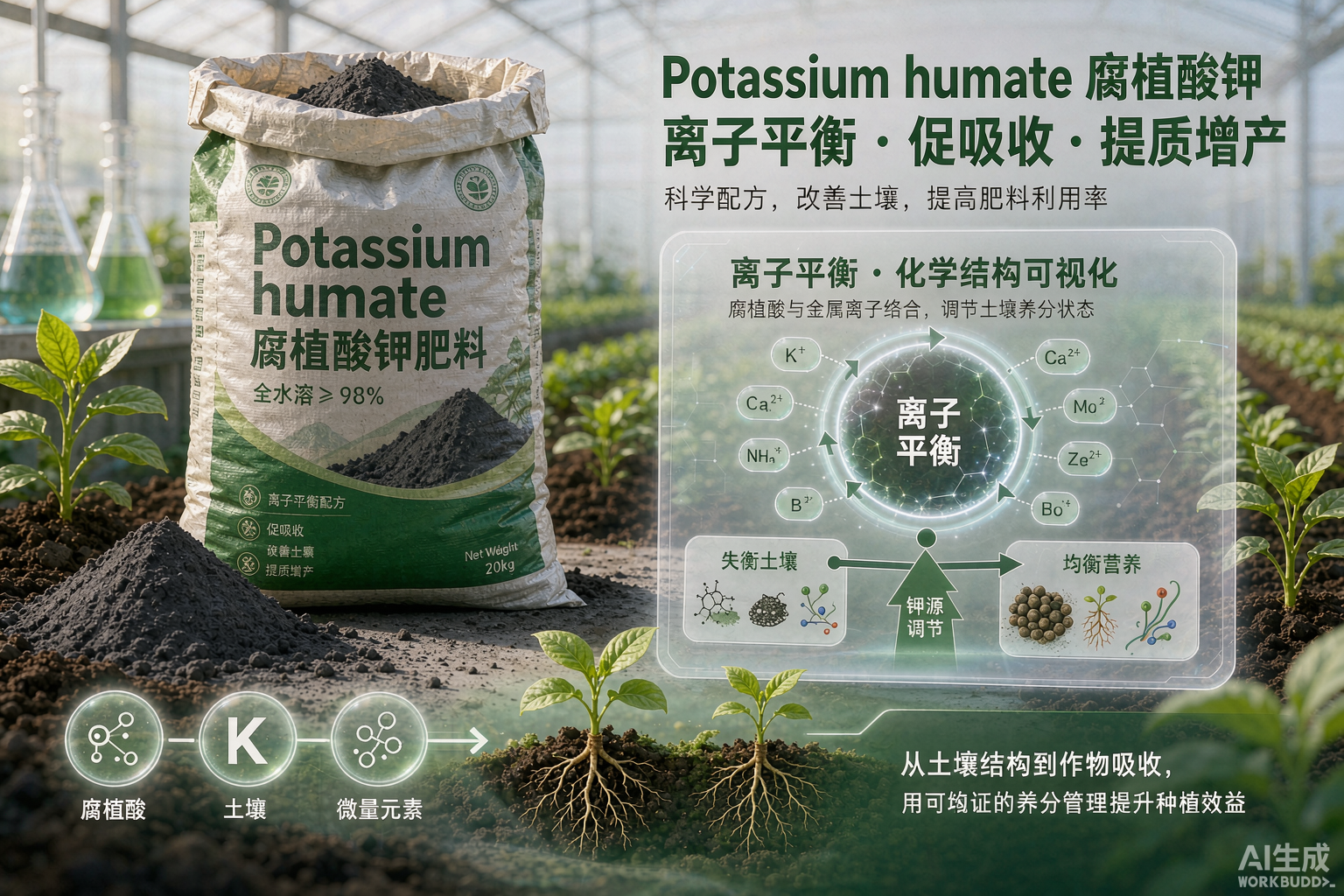
In the agricultural material market, potassium humate, as a popular organic fertilizer, always dazzles people with indicators such as “humic acid content”, “potassium oxide content”, and “sodium ion content” on its packaging. Many people do not know that behind these indicators lies a simple yet crucial chemical logic—the “ion balance principle” of acid-base neutralization reactions. Especially for products marked with a high humic acid content of 65%, if they claim to be “sodium-free”, the potassium oxide content must reach more than 15%. This is not an arbitrary regulation by manufacturers, but an inevitable requirement of chemical principles.
To understand this logic, we first need to start with the core production principle of potassium humate: humic acid itself is an acidic substance, just like the common vinegar we use, with a large number of “acidic sites”. The potassium humate we need is a “water-soluble form” that can dissolve in water and be easily absorbed by plants. To achieve this transformation, an “acid-base neutralization reaction” is necessary—using an alkaline substance to “neutralize” the acidity of humic acid, turning it into a stable humate.
The key here is: Fixed content of humic acid requires a fixed total amount of alkaline substances for neutralization. Just like neutralizing a certain amount of vinegar requires a fixed amount of baking soda, humic acid with a 65% content has a fixed total number of acidic sites. To convert all these humic acids into a water-soluble form, it is necessary to have exactly the right amount of alkaline ions to “fill” these acidic sites—usually potassium ions (K⁺) or sodium ions (Na⁺). This forms a core rule: the total amount of alkaline ions required for neutralization is fixed. If there are more potassium ions, fewer sodium ions are needed; if there are fewer potassium ions, more sodium ions must be added. Otherwise, humic acid cannot be fully converted, and the marked 65% content cannot be achieved.
In industrial production, the main alkaline substances used to neutralize humic acid are potassium hydroxide (KOH) and sodium hydroxide (NaOH). Both substances can provide alkaline ions: potassium hydroxide provides potassium ions (K⁺), and sodium hydroxide provides sodium ions (Na⁺). When pursuing a fixed humic acid content of 65%, if the dosage of potassium hydroxide is reduced, the dosage of sodium hydroxide must be increased accordingly to ensure the completeness of the neutralization reaction—after all, the “total amount of alkaline ions” cannot be reduced.
This adjustment in dosage directly leads to changes in the indicators of the finished potassium humate product: less potassium hydroxide used means a lower total amount of potassium ions in the finished product, which is reflected in the test indicator as a “decrease in potassium oxide (K₂O) content”; more sodium hydroxide used results in a large amount of residual sodium ions, and the “sodium ion content” of the finished product naturally increases. Simply put, this is a “substitution game” between potassium ions and sodium ions, with the core purpose of meeting the total amount of alkaline ions required for humic acid neutralization.
And here comes the most crucial knowledge point: if a potassium humate product with a 65% humic acid content claims to be “sodium-free”, it means that all the alkaline ions required for the neutralization reaction can only come from potassium hydroxide. Through chemical calculations, to fully neutralize 65% humic acid and ensure its stable existence, the content of potassium ions in the finished product must be sufficiently high, and the corresponding potassium oxide (K₂O) indicator must reach more than 15%. This is not a “high standard and strict requirement” from manufacturers, but an inevitable result of chemical laws—if the potassium oxide content is less than 15% and there is no sodium ion supplement, it means the total amount of alkaline ions is insufficient. Part of the humic acid cannot complete the neutralization reaction, resulting in either the humic acid content of the product failing to reach 65% or the finished product having poor stability and being unable to dissolve and use normally.
At this point, some friends may ask: What is the impact of a little more sodium ions? For most crops, a small amount of sodium ions is harmless, but excessive sodium ions can lead to soil salinization. Especially in greenhouses, saline-alkali land and other scenarios, high-sodium products will aggravate soil problems. Therefore, sodium-free potassium humate with high potassium oxide content is a high-quality and high-end product. Its potassium oxide content of more than 15% is essentially a chemical necessity to meet the 65% humic acid content under the premise of “sodium-free”.
In summary, behind the indicators of potassium humate lies the basic law of acid-base neutralization reactions: fixed humic acid content = fixed total amount of alkaline ions = the ebb and flow of potassium ions and sodium ions. 65% humic acid + sodium-free is destined to require potassium oxide ≥ 15%. Next time you choose potassium humate, understanding the correlation between these indicators will help you easily avoid low-quality products!
Interested in JINGFENG’s humic and fulvic acid products? Explore our full range of high-quality biostimulants and organic fertilizers.


Leave a Comment
Your email address will not be published. Required fields are marked *