






Mineral Source Potassium Fulvate Powder I
The Blending-Grade Workhorse for Compound & Water-Soluble Fertilizer
80–100 mesh · 55% fulvic acid · 12% K₂O · 100% water soluble
Product Overview
Mineral Source Potassium Fulvate is JINGFENG’s potassium-rich humate extracted from leonardite, a young oxidized lignite rich in humic acid. It is used worldwide as a fertilizer raw material and plant biostimulant.
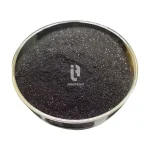
Mineral Source Potassium Fulvate Powder I is the fine-mesh grade of our leonardite-derived fulvate, engineered specifically for fertilizer manufacturers and blenders. At 80–100 mesh, the powder delivers maximum contact surface, dispersing evenly through an NPK blend instead of separating out during transport.
Extracted from high-grade lignite and solubilised with potassium hydroxide, it guarantees 55% fulvic acid and 12% K₂O on a dry basis, dissolving 100% in water with no residue. Unlike generic humate powders that flocculate in hard water, Powder I holds a flocculation limit of 350 mg CaO per litre, staying stable in calcium-rich irrigation water and in UAN blends.
If your line produces compound fertilizer, bulk-blended NPK, or a private-label water-soluble formula, this is the grade that meters cleanly, blends uniformly, and dissolves without clogging your equipment.
Key Benefits
Blends without segregation
80–100 mesh particle size matches the fineness of MAP, DAP and urea powders, so the fulvate stays evenly distributed instead of sifting to the bottom of the bag or pile.
Highest fulvic acid in the Type I family
55% fulvic acid guaranteed — the shortest carbon chain and the most biologically active fraction, absorbed by roots and leaves within hours.
Stable in hard water and UAN
Flocculation limit 350 mg CaO/L. No precipitation in high-calcium water, and stays fully soluble when mixed into UAN solution.
100% soluble, fast wetting
Disperses on contact with water; light agitation gives a clear, residue-free solution that will not block drippers or spray nozzles.
Chelates and buffers
Locks up heavy metals in soil, releases phosphorus fixed by Al³⁺ and Fe³⁺, and buffers soil pH toward the 5.5–7.0 range most crops prefer.
Consistent batch-to-batch
Every lot ships with a COA stating actual test values against HG/T and GB/T methods — not a generic specification sheet.
Technical Specification
| Parameter | Specification |
|---|---|
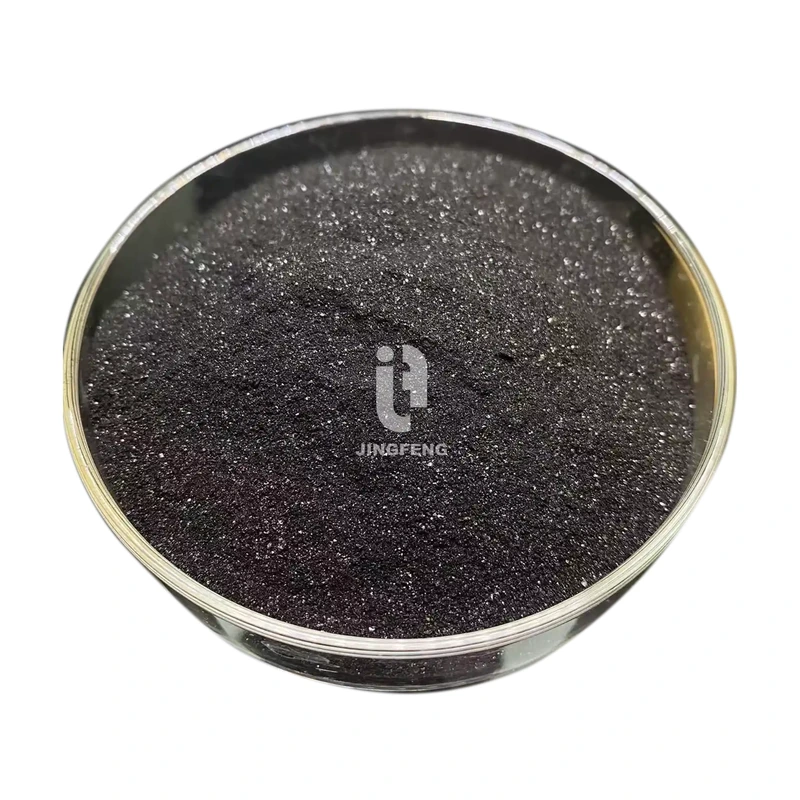
| Appearance | Black powder, 80–100 mesh |
| Product code | JFHA-KFA-P |
| Fulvic acid (dry basis) | 55.0% min |
| Humic acid (dry basis) | 50.0% min |
| Potassium as K₂O (dry basis) | 12.0% min |
| Water solubility (dry basis) | 100% |
| Flocculation limit | 350 mg CaO per 1 L water (CaCl₂ solution) |
| pH (1:100) | 9.0 – 10.0 |
| Moisture | ≤ 15.0% |
| Heavy metals (Pb, As) | Not detected (< 0.0003 ppm), GB 18877-2009 |
| Test methods | HG/T 3278-2018, HG/T 5334-2018, GB/T 33804-2017 |
Specification values are guaranteed minimums on a dry basis. A batch-specific Certificate of Analysis accompanies every shipment.
Form & Solubility
Form: free-flowing black powder, 80–100 mesh. Fine enough to disappear into a blend, coarse enough to keep dust manageable at the intake hopper.
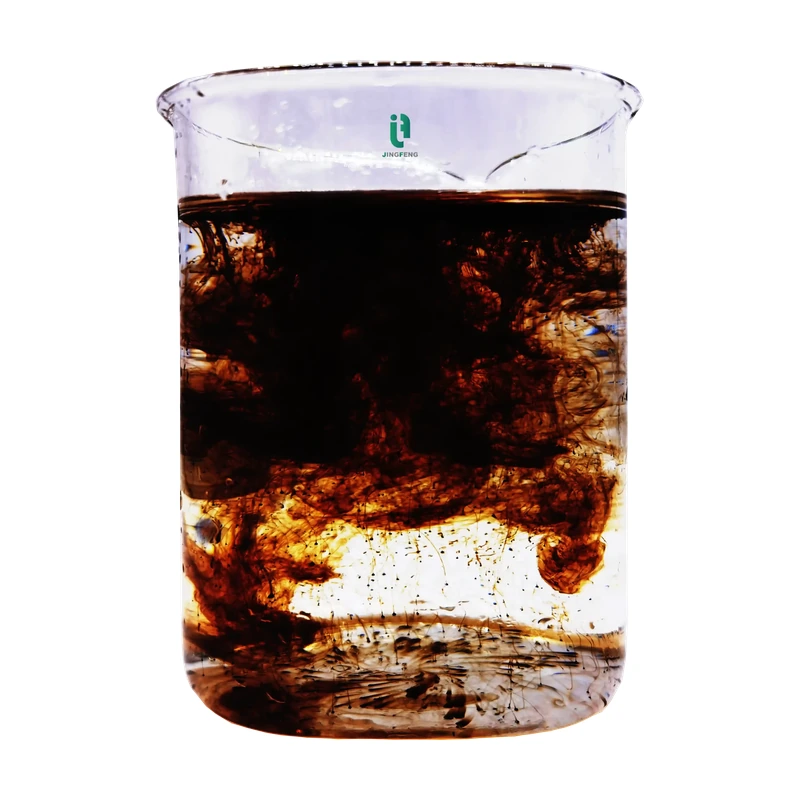
In water: Powder I wets out on contact and disperses within seconds under light agitation — the fastest route to a working solution when you are producing liquid fertilizer at volume. Because the particles are so fine, add the powder onto the surface of moving water rather than dumping it in at once; this prevents the surface crust that slows wetting.
Dust: as with any 80–100 mesh material, some dust is generated during handling. Standard PPE (mask, goggles) and local extraction at the weighing station are recommended.
Not sure between powder and flakes? Powder wins on wetting speed and blend uniformity. Flakes win on dust control and dosing convenience. Micro granule wins on instant dissolution.
Choosing between the five Type I grades
| Grade | Form | Fulvic acid | Best for | Dissolve speed | Dust |
|---|---|---|---|---|---|
| Powder I | 80–100 mesh powder | 55% min | Compound & bulk-blended NPK, WS fertilizer base | Fastest | Some |
| Flakes I (this product) | 2–4 mm flake | 55% min | Liquid fertilizer, fertigation, water-run | Needs agitation | Almost none |
| Micro Granule I | 2–3 mm hollow granule | 50% min | Premium soluble SKUs, hydroponics, foliar | Seconds, no stirring | None |
| Extruded Granules I | 2–4 mm extruded granule | 50% min | Dry blending with granular NPK, broadcasting | Slow (soil moisture) | None |
| Sodium-Free Flakes I | 2–3 mm shiny flake | 50% min | Sodium-sensitive crops, closed hydroponic systems | Needs agitation | Almost none |
Applications & Dosage
| Application | How to use | Rate |
|---|---|---|
| Compound / bulk-blended NPK | Add 5–10 kg per tonne of finished blend, or 1 kg per 100 kg urea. Blend in the rotary drum with the other powders. | 5–10 kg/t |
| Water-soluble fertilizer formula | Use as the humic base of a WS formulation at 5–10% of total solids. Fully compatible with MAP, MKP, potassium sulphate and chelated trace elements. | 5–10% of formula |
| Foliar spray | Dilute 1:3000–1:5000; spray every 7–15 days. Apply early morning or late afternoon. | 0.2–0.5 kg/mu |
| Drip / fertigation | Pre-dissolve in a small tank, filter, then meter into the irrigation line. | 0.5–1.0 kg/mu |
| Seed soaking / root dip | 1:2000 solution, soak 10–24 h (shorter in warm weather). | 1:2000 |
Packaging & Storage
| Pack size | Description |
|---|---|
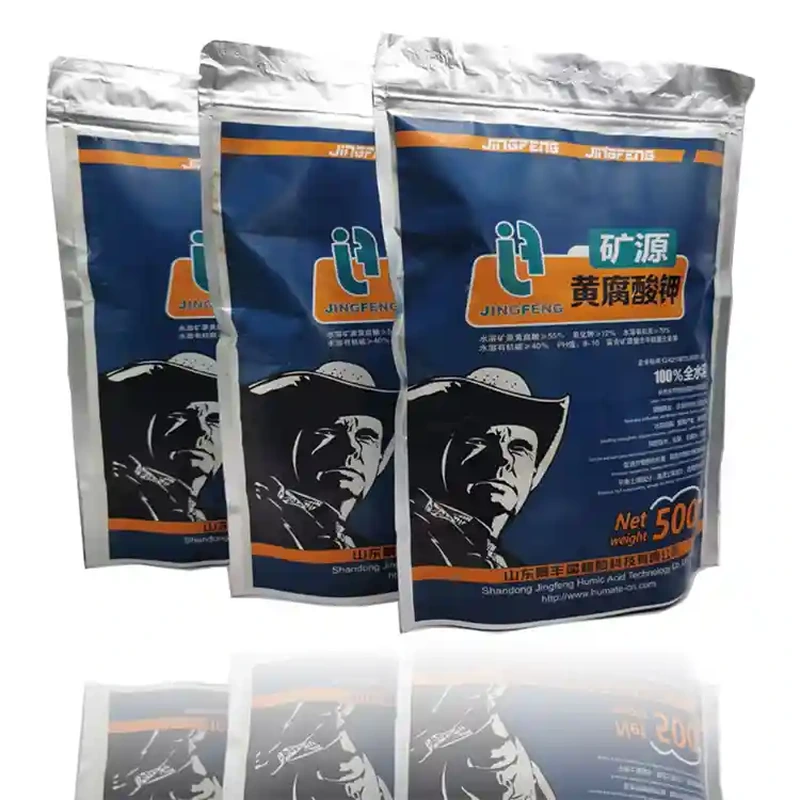
| 1 kg / 5 kg / 10 kg | Printed aluminium foil bag — retail and sample size |
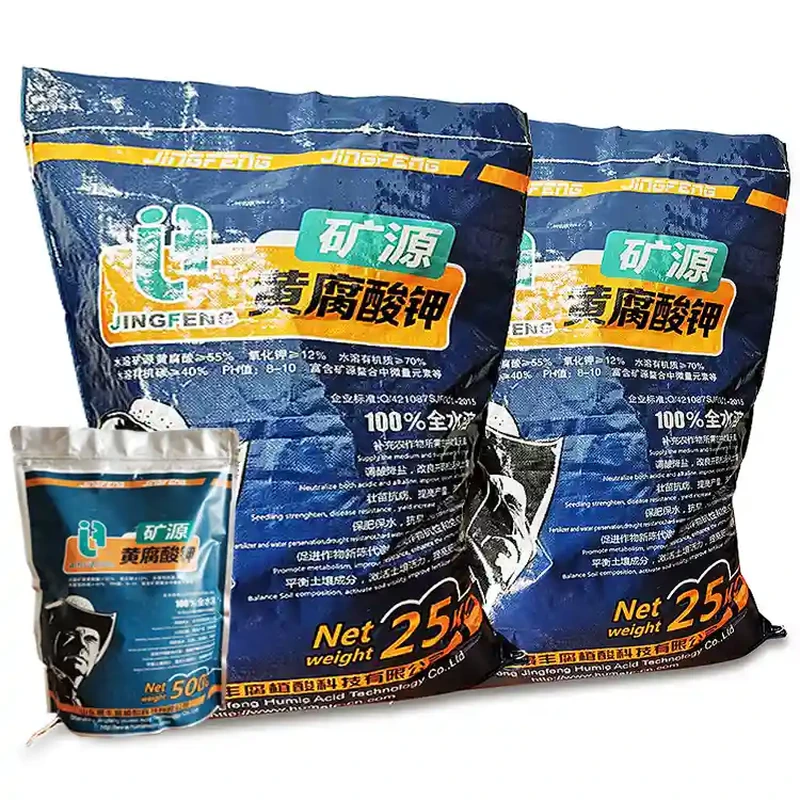
| 20 kg / 25 kg | Woven or paper bag with inner PE liner |
| 20 kg / 25 kg | Colour-printed PP/PE bag with inner liner — private label ready |
| 1000–1100 kg | Jumbo bag with discharge spout |
Storage: Store in a cool, dry, well-ventilated place. Reseal opened bags promptly — fulvate powder is hygroscopic and will cake if left exposed. Under proper storage the product is stable for 3 years.
Custom packaging, private-label printing and OEM specifications are available on request. Packaging photos are available in the product gallery.
Successful Cases
Compound NPK plant, Shandong
A 200,000 t/year compound fertilizer producer replaced a generic 40% fulvate with Powder I at 8 kg/t. Segregation complaints dropped to zero and the blend’s water-soluble humic content became a listed selling point on their spec sheet.
Explore agriculture applications → Agriculture · FertigationWater-soluble fertilizer formulator, Vietnam
Uses Powder I as the humic component of a 20-20-20+HA formula. Reported no sedimentation after 30 days of tank storage and no nozzle blockage across two growing seasons.
Explore agriculture applications → Agriculture · FertigationTomato greenhouse cluster, Mexico
0.8 kg/mu per cycle through drip lines on calcareous soil. Growers recorded firmer fruit and a measurable drop in blossom-end rot.
Explore agriculture applications →Full case studies with crop data are published in our application sectors.
Frequently Asked Questions
What is the difference between Powder I and Flakes I?
Chemically they are the same material with identical COA values — the difference is physical form. Powder (80–100 mesh) wets faster and blends more uniformly into compound fertilizer. Flakes (2–4 mm) generate almost no dust, flow better through dosing equipment and are preferred for liquid fertilizer production. Choose by your process, not by chemistry.
Can it be blended directly with urea or DAP?
Yes. Powder I is routinely blended with urea, MAP, DAP, MKP and potassium sulphate. Add at 5–10 kg per tonne of finished blend and run it through the normal blending cycle. Because the particle size is close to these carriers, separation during transport is minimal.
Will it clog my drip lines?
Not when handled correctly. Powder I is 100% water soluble, but always pre-dissolve it in a small tank and filter before it enters the drip system. This one step removes any undissolved grit and is the standard practice on every professional farm we supply.
Is it stable in hard water?
Yes — that is a defining property. The flocculation limit is 350 mg CaO per litre, well above what most irrigation water contains. Standard potassium humate flocculates and drops out; Powder I stays in solution.
What is the minimum order and lead time?
Standard stock item. MOQ is one pallet for stocked packaging; lead time is typically 7–15 days ex-works, faster for repeat specifications. Custom packaging and private labelprinting are available on request.
Do you provide a COA with every shipment?
Yes. Each batch ships with a Certificate of Analysis showing tested values for fulvic acid, humic acid, K₂O, pH and heavy metals, referenced to the HG/T and GB/T test methods. We also hold third-party SGS reports on file.
Is it allowed in organic farming?
Our fulvic acid line is CERES organic certified to NOP standard. Tell us your target market at enquiry stage and we will attach the current certificate valid for that programme.
Need a quotation or a sample?
Tell us your application, target market and packaging — we will come back with specification, price and lead time.
Request a Quote
 8618920222224