






Extruded Potassium Fulvate Granules I
The Dry-Blend Specialist — Sized to Match Granular NPK
2–4 mm extruded granule · 50% fulvic acid · 10–12% K₂O · built for dry blending
Product Overview
Mineral Source Potassium Fulvate is JINGFENG’s potassium-rich humate extracted from leonardite, a young oxidized lignite rich in humic acid. It is used worldwide as a fertilizer raw material and plant biostimulant.
Extruded Potassium Fulvate Granules I is the grade built for one job: mixing into dry granular fertilizer without falling apart. Produced by hydraulic extrusion at 2–4 mm, it is the hardest and driest form we make.
Two properties matter here. Crush strength — the granules survive the mechanical punishment of a bulk-blending drum, a conveyor drop and a bagging line without degrading back into fines. Low moisture — because the granule carries very little water, it blends with granular NPK without setting off the moisture migration that turns a blend into a solid mass.
The result is a fulvate granule whose size and density closely match granular NPK, which is what stops the blend from segregating. A powder sifts to the bottom of the pile; a 2–4 mm extruded granule stays where you put it.
One operational rule, stated up front: once blended, use the blend promptly. The same low moisture that makes this grade stable on its own makes it eager to pull moisture from its surroundings in a blend. Do not warehouse a finished blend for months — see the note below.
Key Benefits
High crush strength
Hydraulic extrusion produces a dense granule that resists attrition. Very low fines generation through blending, handling and bagging.
Low moisture content
The driest grade in the family. Less risk of caking in storage and less moisture migration at the start of a blend.
Particle size matched to granular NPK
2–4 mm sits in the same size band as standard granular fertilizers, so the blend stays homogeneous instead of segregating in the bag or spreader.
Uniform spreading
Because it does not segregate, a blended product spreads evenly — every pass of the spreader delivers the intended ratio.
No dust at the blender
A hard granule generates essentially no dust, keeping the blending hall and the operator clean.
100% water soluble
Hard in the bag, fully soluble in the field. Once in soil moisture it dissolves completely and releases fulvic acid to the root zone.
Technical Specification
| Parameter | Specification |
|---|---|
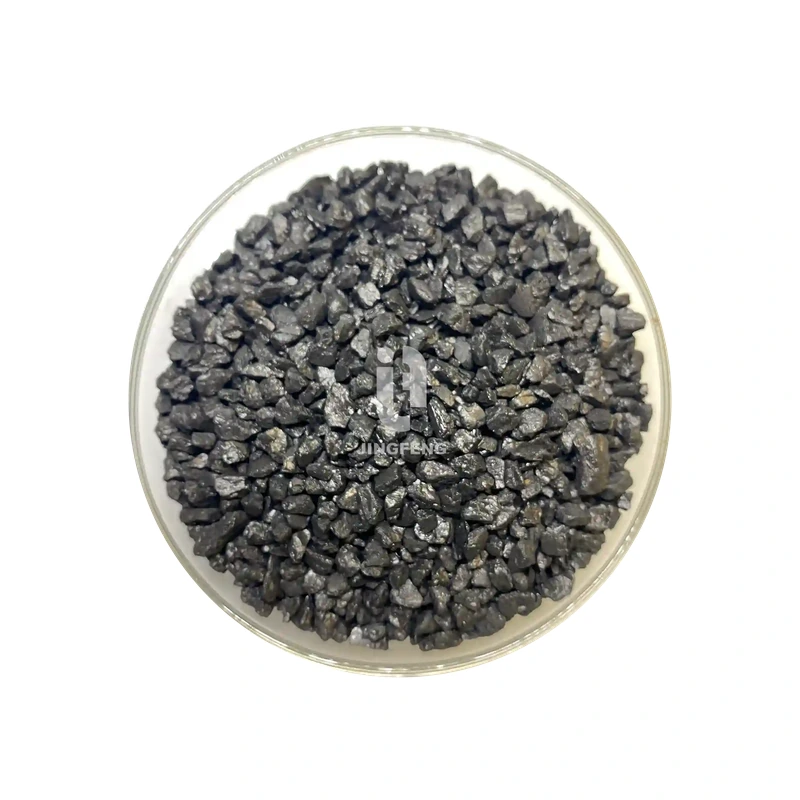
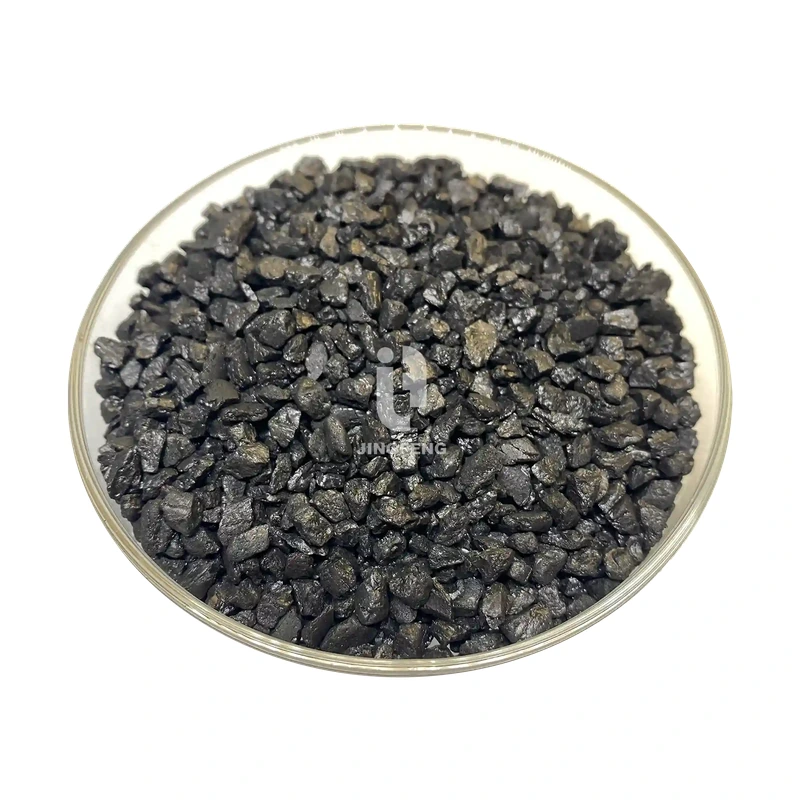
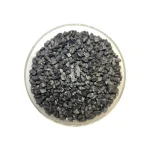
| Appearance | Black granule, 2–4 mm, matte (non-shiny) finish |
| Product code | JFHA-KFA-G |
| Process | Hydraulic extrusion |
| Fulvic acid (dry basis) | 50.0% min |
| Humic acid (dry basis) | 50.0% min |
| Potassium as K₂O (dry basis) | 10.0 – 12.0% |
| Water solubility (dry basis) | 100% |
| pH (1:100) | 9.0 – 10.0 |
| Granule size | 2–4 mm |
| Heavy metals (Pb, As, Hg) | Not detected (< 0.0003 ppm), GB 18877-2009 |
| Test methods | HG/T 3278-2018, HG/T 5334-2018, GB/T 33804-2017 |
Specification values are guaranteed minimums on a dry basis. A batch-specific Certificate of Analysis accompanies every shipment.
Form & Solubility
Form: hard, dense black granule, 2–4 mm, matte finish, produced by hydraulic extrusion.
In the blender: this is the grade’s home ground. Crush strength keeps the granule intact through drum blending, conveying and bagging — you put granules in and granules come out, not dust. The 2–4 mm size band matches granular NPK, MAP and urea prills closely enough that the blend stays uniform through transport and through the spreader.
In the field: 100% water soluble. Soil moisture, irrigation or rain dissolves the granule completely and delivers the fulvic acid into the root zone. It is slower to appear than a dissolved application, which is exactly what a basal or blended application wants.
The one rule — use the blend promptly. The granule’s low moisture content makes it hygroscopic in a blend: over time it will draw moisture from the surrounding fertilizer and from the air, soften, and eventually powder. Blend close to the application date and do not carry a finished blend across a full season. Stored on its own in sealed packaging, the granule itself is stable for 2 years.
Choosing between the five Type I grades
| Grade | Form | Fulvic acid | Best for | Dissolve speed | Dust |
|---|---|---|---|---|---|
| Powder I | 80–100 mesh powder | 55% min | Compound & bulk-blended NPK, WS fertilizer base | Fastest | Some |
| Flakes I (this product) | 2–4 mm flake | 55% min | Liquid fertilizer, fertigation, water-run | Needs agitation | Almost none |
| Micro Granule I | 2–3 mm hollow granule | 50% min | Premium soluble SKUs, hydroponics, foliar | Seconds, no stirring | None |
| Extruded Granules I | 2–4 mm extruded granule | 50% min | Dry blending with granular NPK, broadcasting | Slow (soil moisture) | None |
| Sodium-Free Flakes I | 2–3 mm shiny flake | 50% min | Sodium-sensitive crops, closed hydroponic systems | Needs agitation | Almost none |
Applications & Dosage
| Application | How to use | Rate |
|---|---|---|
| Bulk-blended (BB) granular fertilizer | Blend with granular NPK, urea or MAP in the drum at 10–25 kg/t. Size-matched, so the blend stays uniform. Use the blend within the season. | 10–25 kg/t |
| Mechanised broadcasting | Apply with the basal dose using a spreader. Uniform granule size gives even distribution across the swath. | 10–20 kg/ha |
| Granular compound fertilizer production | Added at the blending stage for compound lines that market a humic-fortified product. | as per formula |
| Band / side-dress application | Placed beside the seed row or banded at side-dress; dissolves with soil moisture through the season. | 10–20 kg/ha |
| Orchard and plantation basal feed | Broadcast under the canopy ahead of the rainy season; the granule releases as moisture arrives. | 15–25 kg/ha |
Packaging & Storage
| Pack size | Description |
|---|---|
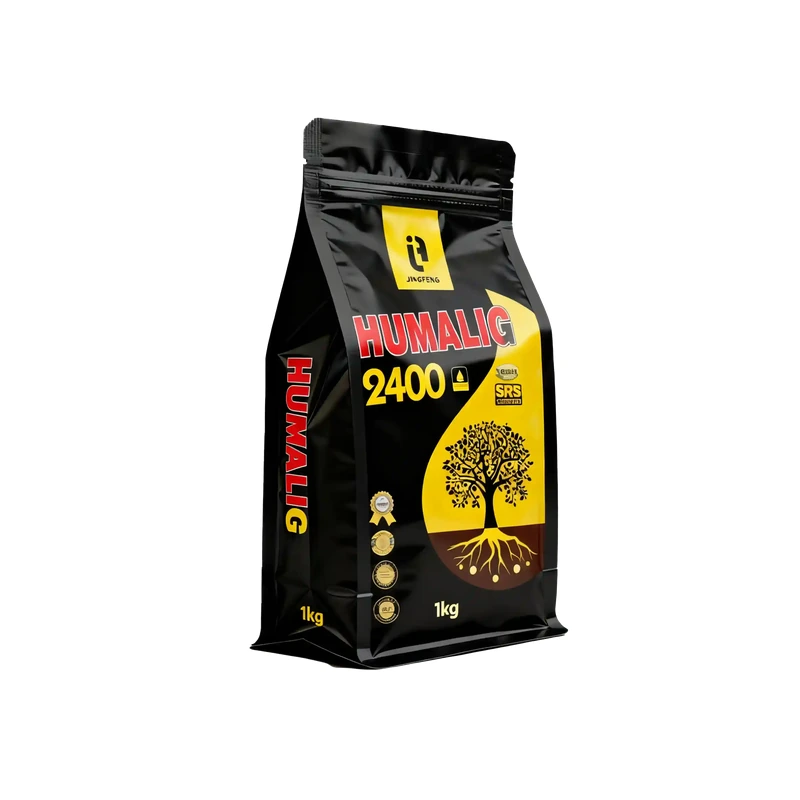
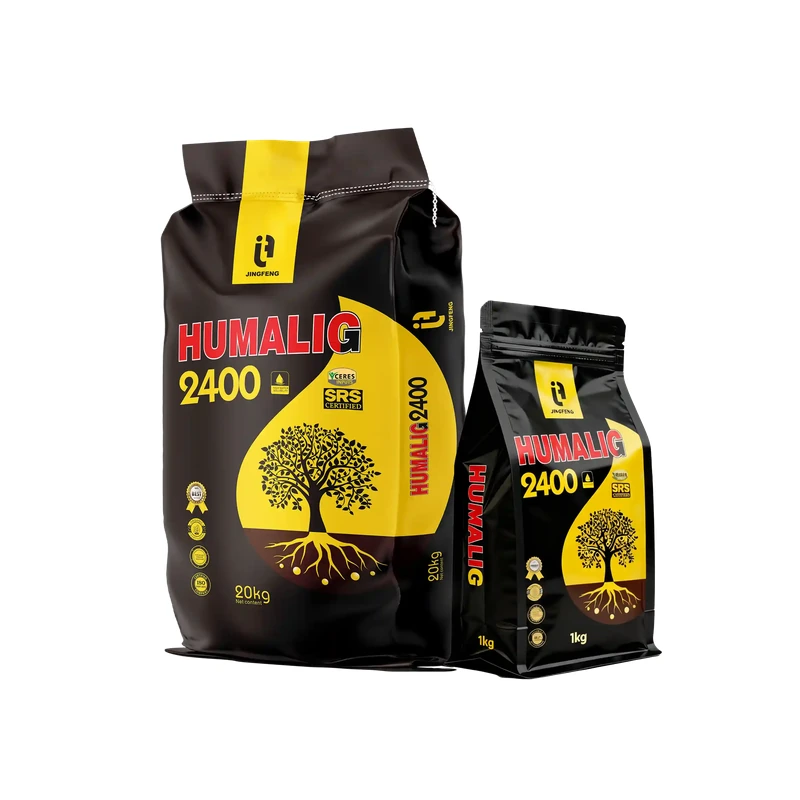
| 1 kg | Printed aluminium foil bag — sample and trial size |
| 20 kg | Kraft bag with inner liner |
| 25 kg | Woven bag with inner PE liner |
| 1000–1100 kg | Jumbo bag with discharge spout |
Storage: Store sealed in a cool, dry, well-ventilated place. **Critical: blend only as much as you will use in the near term.** The low-moisture granule is hygroscopic within a blend and will soften and powder if a finished blend is warehoused for months. Unopened in original packaging, the granule keeps 2 years.
Custom packaging, private-label printing and OEM specifications are available on request. Packaging photos are available in the product gallery.
Successful Cases
Bulk blend plant, Brazil
Blends at 20 kg/t into a granular NPK. Chose the extruded grade after a powder version segregated during road transport — the 2–4 mm match eliminated the complaint entirely.
Explore agriculture applications → Agriculture · FertigationMechanised wheat operation, Kazakhstan
15 kg/ha broadcast with the basal N. Uniform granule spread meant no striping and no fulvate hot-spots across the field.
Explore agriculture applications → Agriculture · FertigationOil palm plantation, Indonesia
Ring-applied ahead of the monsoon; the granule dissolved gradually with rainfall and fed the root zone across the wet season.
Explore agriculture applications →Full case studies with crop data are published in our application sectors.
Frequently Asked Questions
Why must I use the blend promptly?
Because the granule is manufactured at very low moisture — that is what gives it strength and shelf stability on its own. But in a blend it acts as a moisture sink, drawing humidity from the other components and from the air. Over weeks to months it softens and powders. Blend close to spreading and you never see the problem; warehouse a finished blend all season and you will.
How is this different from the Micro Granule I?
Opposite ends of the spectrum. Micro Granule I is a hollow spray-dried granule designed to dissolve in seconds for liquid application. Extruded Granules I is a dense, hard granule designed to survive dry blending and dissolve slowly in soil. One is for the tank, the other for the spreader.
Will the granule break down into dust in my blender?
Very little. Hydraulic extrusion gives the highest crush strength in our range, and attrition losses in a standard drum blender are minimal. If you are running an unusually aggressive or long blending cycle, tell us and we will advise on the grade.
Is it still 100% water soluble if it is so hard?
Yes. Hardness and solubility are not in tension here — the granule is dense, but it is still fully soluble. It simply needs soil moisture or irrigation to work through it, which is the release pattern a basal application wants.
What blending rate do you recommend?
10–25 kg per tonne of finished blend is the common range, depending on the humic content you want to claim on the label. Tell us your target spec and we will help you set the rate.
What is the minimum order and lead time?
Made to order on an extrusion campaign. MOQ is higher than stocked powder and flake grades; typical lead time 15–25 days ex-works. Share your volume and we will quote firm numbers.
Do you supply a COA per batch?
Yes, with tested values for humic acid, K₂O, pH and the heavy metal panel, referenced to HG/T and GB/T methods.
Need a quotation or a sample?
Tell us your application, target market and packaging — we will come back with specification, price and lead time.
Request a Quote
 8618920222224