





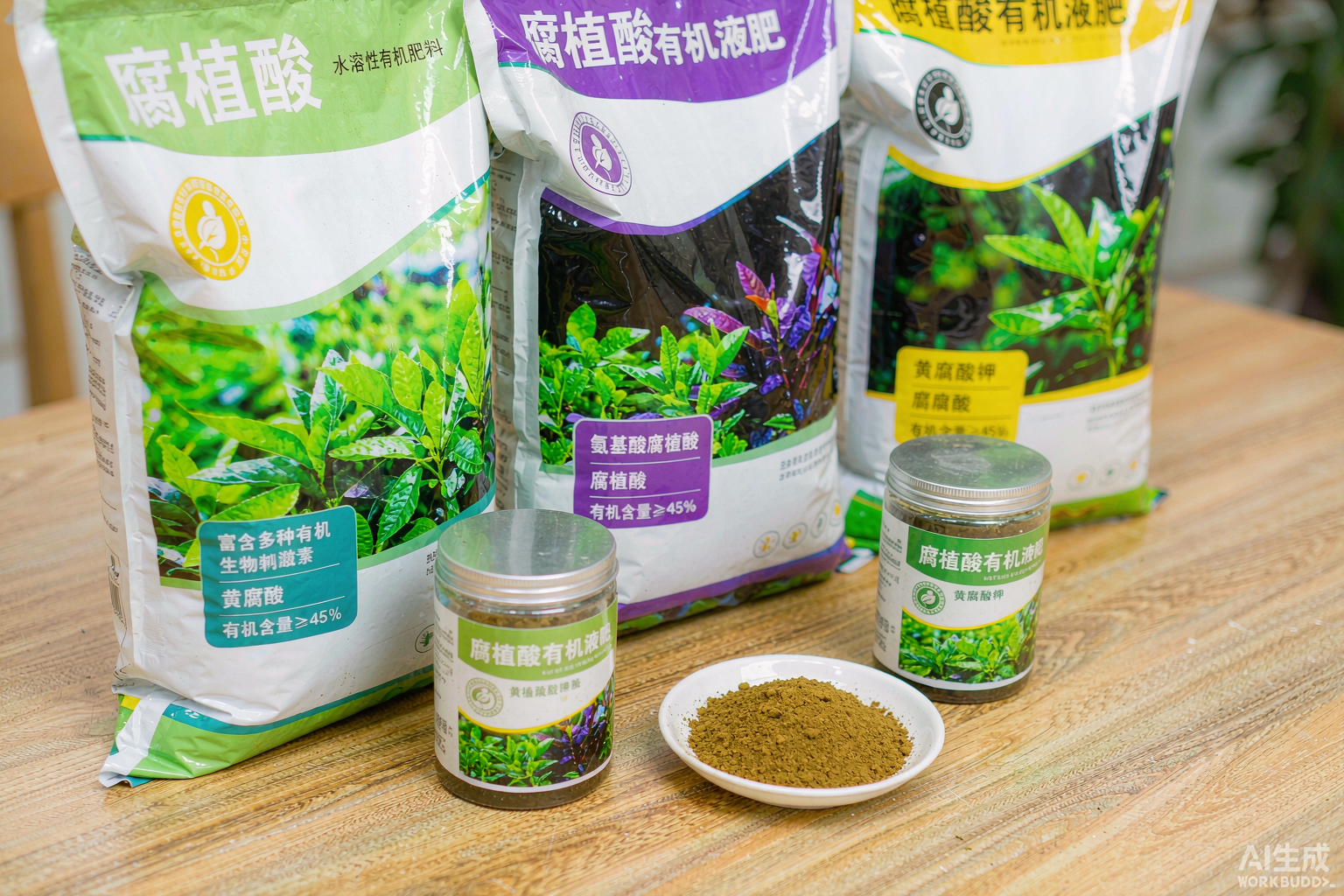
In agricultural production, the selection of organic fertilizers must focus on three core factors: soil needs, crop characteristics, and growth stages. This is particularly true for humic acid-based fertilizers (humic acid, amino-humic acid, potassium humate, mineral-source potassium humate, biochemical fulvic acid potassium) and seaweed extract, as their distinct compositions and functions often lead to suboptimal results if chosen blindly. Below is a breakdown of specific selection methods, organized into three layers: product characteristics → suitable scenarios → selection logic.
I. Core Characteristics and Suitable Scenarios of Six Organic Fertilizer Types
1. Basic Humic Acid
Core Nature: A macromolecular organic acid (molecular weight: 10³-10⁶) extracted from natural organic matter such as peat and lignite. It contains no additional nutrients, with its core value lying in improving soil physical structure.
Key Functions: Enhances soil cation exchange capacity (CEC) to boost water and nutrient retention; promotes the formation of soil aggregate structure to alleviate compaction; activates soil microbial activity (e.g., nitrogen-fixing bacteria, phosphorus-solubilizing bacteria).
Suitable Scenarios:
✅ Soil compaction and poor water retention caused by long-term continuous cropping (e.g., protected vegetable greenhouses);
✅ Newly reclaimed land, sandy soil, and other soils with low basic fertility;
❌ Scenarios requiring rapid nutrient supplementation (e.g., crop nutrient deficiency periods) or short-term growth promotion (effects are slow, taking 1-2 growth cycles to manifest).
2. Amino-Humic Acid
Core Nature: A “humic acid + amino group” composite system formed by chemical modification of humic acid and amino compounds (e.g., amino acids, urea). It combines both soil improvement and nutrient absorption promotion functions.
Key Advantages: Amino groups enhance the absorption efficiency of nitrogen, phosphorus, and other nutrients by crops (15%-20% higher than ordinary humic acid); retains the soil-improving properties of humic acid, while its small-molecule fraction (molecular weight < 10³) can be directly absorbed by crop leaves.
Suitable Scenarios:
✅ Crop growth periods requiring both “soil improvement + efficient nutrient utilization” (e.g., fruit expansion stage of fruit trees, jointing stage of wheat);
✅ Alkaline soils (pH > 8.0), where it alleviates the fixation of micronutrients such as iron and zinc (amino groups chelate micronutrients);
❌ Extremely barren soils (basic fertility must be supplemented first before using it to improve efficiency).
3. Potassium Humate
Core Nature: A “potassium humate salt” formed by the reaction of humic acid with potassium hydroxide. Its core function is dual-action soil improvement + potassium supplementation (potassium content: 8%-12%).
Key Differences: Compared to ordinary humic acid, it adds “potassium supplementation”; potassium ions also promote the solubility of humic acid in water (better water solubility than ordinary humic acid, suitable for drip irrigation).
Suitable Scenarios:
✅ Crops requiring potassium supplementation and soil improvement (e.g., cotton boll stage, grape color transition stage—periods with high potassium demand and high risk of soil compaction);
✅ Potassium supplementation for chloride-sensitive crops (e.g., strawberries, tobacco, potatoes) (chloride-free, avoiding chloride toxicity);
❌ Crops with low potassium demand (e.g., leafy vegetables, which require nitrogen primarily; excessive potassium supplementation inhibits calcium absorption).
4. Mineral-Source Potassium Humate
Core Nature: Potassium humate extracted exclusively from mineral sources such as “weathered coal, lignite, and peat.” It has high purity (humic acid content ≥ 60%, potassium content ≥ 8%) and is the “high-activity variant” of potassium humate.
Key Advantages: The aromatic ring structure of mineral-source humic acid is more stable, with higher CEC (up to 150-200 cmol/kg—2-3 times that of biochemical humic acid), delivering stronger soil improvement and stress resistance effects; it also contains no heavy metals (compliant with GB/T 35118-2023 standards).
Suitable Scenarios:
✅ Soils with severe salinization (e.g., protected agricultural soils in northern China, where it reduces soil electrical conductivity and improves the root growth environment);
✅ High-yield cultivation of cash crops (e.g., citrus, kiwifruit—requiring long-term maintenance of soil health and potassium supplementation);
❌ Field crops with limited budgets (30%-50% more expensive than biochemical fulvic acid potassium, offering lower cost-effectiveness for general needs).
5. Biochemical Fulvic Acid Potassium
Core Nature: “Small-molecule fulvic acid + potassium” extracted from fermented biomass such as crop straw, mushroom residue, and molasses (molecular weight < 10³—the most active component in humic acid). Potassium content: 5%-10%.
Key Advantages: 100% water-soluble, with rapid absorption via leaves and roots (fast-acting, visible leaf greening within 3-5 days); promotes root germination (especially fibrous root growth) and enhances crop stress resistance (drought, low temperature).
Suitable Scenarios:
✅ Crop seedling stage/after transplanting (e.g., tomato post-planting, wheat regreening stage—requiring rapid root promotion and seedling establishment);
✅ Foliar spraying or drip irrigation (small molecules penetrate easily, suitable for precision fertilization in protected agriculture);
❌ Long-term soil improvement (low CEC, with soil improvement effects only 1/3 that of mineral-source potassium humate—must be used in combination with other humic acid-based fertilizers).
6. Seaweed Extract
Core Nature: A natural biostimulant extracted from brown algae (e.g., Ascophyllum nodosum, Macrocystis pyrifera). It contains no humic acid, with core components including “seaweed polysaccharides + natural hormones (cytokinins, auxins) + micronutrients (iodine, selenium).”
Key Functions: Enhances crop stress resistance (e.g., high temperature, pests, and diseases—seaweed polysaccharides strengthen cell wall toughness); improves crop quality (e.g., increasing fruit sugar content, extending shelf life); promotes flower bud differentiation (via natural cytokinins).
Suitable Scenarios:
✅ Critical crop growth stages (e.g., fruit tree flowering stage, vegetable fruiting stage—requiring flower/fruit retention and quality improvement);
✅ Extreme environmental stress (e.g., cotton in arid regions, strawberries in low-temperature regions—requiring enhanced stress resistance);
❌ Soils with severe barrenness/compaction (no soil improvement function—must be used in combination with humic acid-based fertilizers).
II. Four-Step Precision Selection: Matching Logic from Needs to Products
Step 1: Clarify Core Needs—”Soil Priority or Crop Priority?”
| Core Need | Priority Categories | Categories to Avoid |
| Soil improvement (compaction/salinization) | Mineral-Source Potassium Humate > Ordinary Humic Acid | Biochemical Fulvic Acid Potassium, Seaweed Extract |
| Rapid potassium supplementation + soil improvement | Potassium Humate (mineral-source preferred) | Basic Humic Acid, Seaweed Extract |
| Root promotion/seedling establishment + emergency nutrient supplementation | Biochemical Fulvic Acid Potassium > Amino-Humic Acid | Basic Humic Acid, Mineral-Source Potassium Humate |
| Stress resistance enhancement/quality improvement | Seaweed Extract + Amino-Humic Acid | Ordinary Humic Acid, Potassium Humate |
Step 2: Align with Crop Type—”Fertilizer Demand Determines Variety”
Field Crops (wheat, corn): Prioritize cost-effectiveness. Opt for “Basic Humic Acid (basal application for soil improvement) + Biochemical Fulvic Acid Potassium (foliar spraying at seedling stage)”; avoid high-cost Mineral-Source Potassium Humate.
Cash Crops (fruit trees, vegetables): Balance quality and soil health. Recommend “Mineral-Source Potassium Humate (basal application) + Seaweed Extract (foliar spraying at flowering/fruit expansion stage).”
Chloride-Sensitive Crops (strawberries, tobacco): For potassium supplementation, select “Potassium Humate/Mineral-Source Potassium Humate” exclusively; avoid chloride-containing potassium fertilizers (e.g., Potassium Chloride/KCl).
Step 3: Match Growth Stages—”Needs Vary by Stage”
Before sowing/transplanting (basal fertilizer): Use “Mineral-Source Potassium Humate/Basic Humic Acid” to slowly improve soil and lay the foundation for root growth.
Seedling/regreening stage (topdressing): Use “Biochemical Fulvic Acid Potassium” to rapidly promote root growth, establish seedlings, and reduce seedling mortality.
Flowering/fruit expansion stage (topdressing): Use “Seaweed Extract + Potassium Humate” to retain flowers/fruits, supplement potassium, and improve yield and quality.
Stress conditions (drought/low temperature): Apply foliar spraying of “Seaweed Extract + Amino-Humic Acid” for dual stress resistance enhancement.
Step 4: Consider Fertilization Method—”Water Solubility Determines Application Scenario”
| Fertilization Method | Suitable Varieties (Water Solubility Order) | Notes |
| Drip irrigation/sprinkler irrigation | Biochemical Fulvic Acid Potassium > Mineral-Source Potassium Humate > Amino-Humic Acid | Filtration required to prevent pipe clogging |
| Foliar spraying | Seaweed Extract > Biochemical Fulvic Acid Potassium > Amino-Humic Acid | Concentration: 0.1%-0.3%; avoid application at noon |
| Soil broadcasting/furrow application | Basic Humic Acid > Mineral-Source Potassium Humate | Incorporate into soil via tillage to promote decomposition |
III. Pitfall Avoidance Guide: Common Misconceptions
“Biochemical Fulvic Acid Potassium = Mineral-Source Fulvic Acid Potassium”: Incorrect! Biochemical fulvic acid potassium is derived from fermentation, while mineral-source fulvic acid potassium comes from minerals. The former has weak soil improvement effects but fast results, while the latter has strong soil improvement effects and long-lasting benefits—choose based on specific needs.
“Seaweed Extract can replace humic acid”: Incorrect! Seaweed extract has no soil improvement function; it only enhances crop stress resistance and quality. For severe soil issues, it must be used in combination with humic acid-based fertilizers.
“Choose potassium humate for high potassium needs, regardless of crop type”: Incorrect! Leafy vegetables (e.g., Chinese cabbage) primarily require nitrogen; excessive potassium supplementation inhibits calcium absorption, leading to “tip burn.” In such cases, Basic Humic Acid is more appropriate.
IV. Conclusion: Combine as Needed for Maximum Effectiveness
A single fertilizer type rarely meets complex agricultural needs. Recommended “1+1” combination schemes:
Soil compaction + potassium deficiency: Mineral-Source Potassium Humate (basal application) + Biochemical Fulvic Acid Potassium (drip irrigation at seedling stage);
Saline-alkaline soil + quality improvement: Mineral-Source Potassium Humate (basal application) + Seaweed Extract (foliar spraying);
Continuous cropping greenhouses + root promotion: Basic Humic Acid (basal application) + Amino-Humic Acid (topdressing).
Ultimately, remember this guideline: “For soil improvement, choose mineral-source; for growth promotion, choose biochemical; for stress resistance, choose seaweed extract; for potassium supplementation, choose humate potassium.” Flexibly combine these fertilizers based on actual needs to maximize the value of organic fertilizers.
Interested in JINGFENG’s our application guides products? Explore our full range of high-quality biostimulants and organic fertilizers.



Leave a Comment
Your email address will not be published. Required fields are marked *