





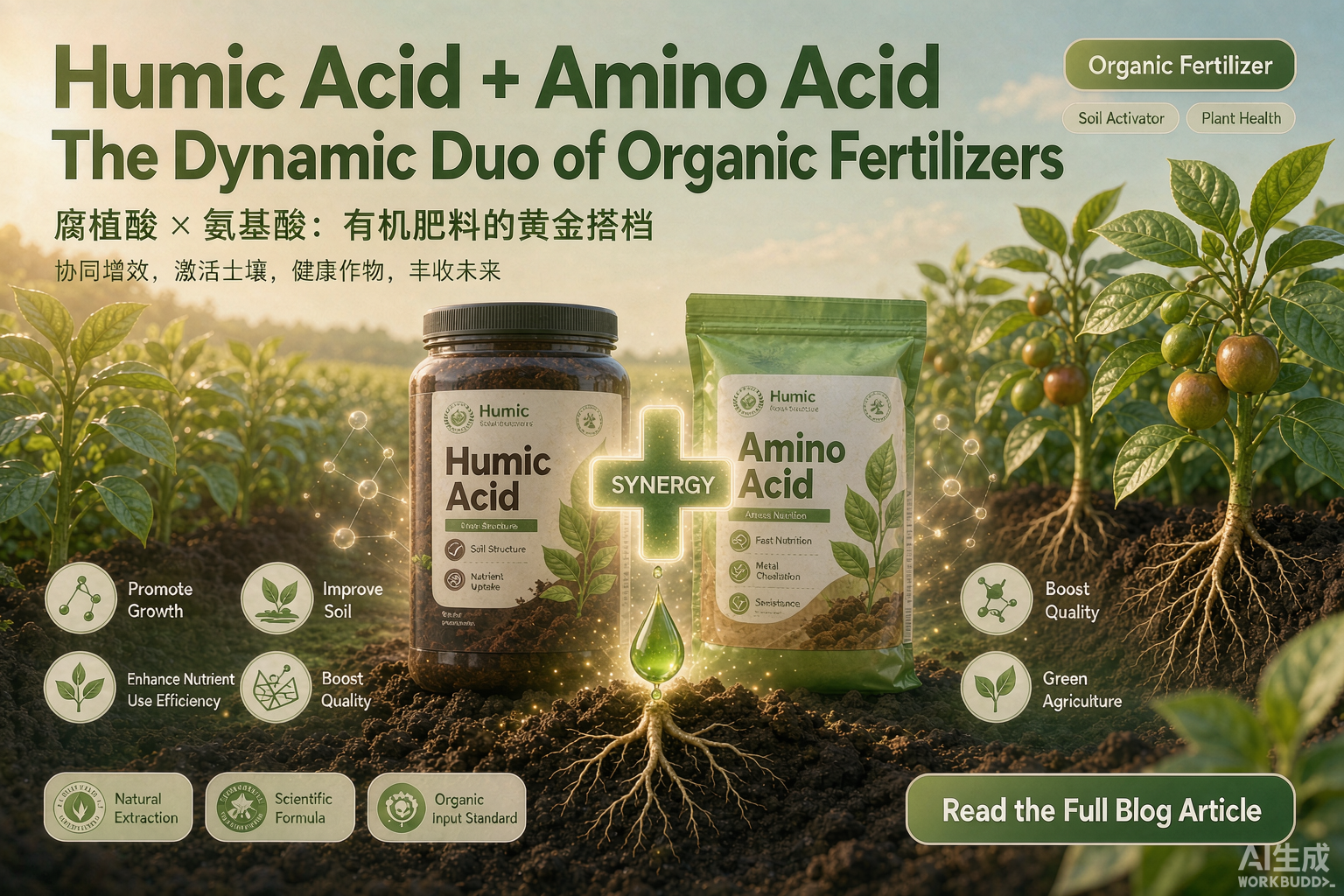
In the pursuit of sustainable and high-yield agriculture, the combination of humic acid and amino acid has emerged as a powerful solution. These two natural organic substances, each with unique properties, create a synergistic effect that goes beyond individual applications—enhancing soil health, boosting crop growth, improving nutrient utilization, and strengthening stress resistance. As a leading exporter of humic acid, amino acids, seaweed extracts, and EDDHA-chelated trace elements, we draw on years of research and global field experience to explore the complementary roles of humic acid and amino acid, providing a comprehensive guide for their scientific application in agriculture.
I. Understanding Humic Acid and Amino Acid: Core Properties and Roles
To fully grasp their synergistic value, it is essential to first understand the basic characteristics and individual functions of humic acid and amino acid in agricultural systems.
1. Humic Acid: The “Soil Activator”
Humic acid is a complex mixture of organic compounds formed by the decomposition and transformation of plant and animal residues over long periods. Primarily sourced from lignite, peat, and leonardite, it is widely recognized as a key soil amendment due to its unique properties:
- Soil Structure Improvement: Humic acid contains a large number of active groups (carboxyl, hydroxyl, phenolic hydroxyl) that can bind soil particles to form stable aggregates. This reduces soil compaction, increases porosity, improves water infiltration and retention capacity—critical for both clay and sandy soils.
- Nutrient Chelation and Retention: It can chelate with essential trace elements (iron, zinc, copper, manganese) to form easily absorbable complexes, preventing nutrient leaching and improving fertilizer use efficiency. Studies show that humic acid can increase the utilization rate of chemical fertilizers by 20%-30%.
- Soil Microbial Regulation: Acting as a food source for beneficial soil microbes (such as Bacillus and actinomycetes), humic acid promotes their proliferation, enhances soil enzyme activity, and optimizes the soil microecological environment.
2. Amino Acid: The “Crop Nutrient Accelerator”
Amino acids are the basic building blocks of proteins, derived from the hydrolysis of plant or animal proteins (e.g., soybean meal, fish meal, hair). They play a vital role in crop growth and development:
- Direct Nutrient Supply: Amino acids are directly absorbable by crops, providing essential nitrogen and carbon sources to support cell division, growth, and metabolism. They are particularly effective during critical growth stages (seedling, flowering, fruiting).
- Growth Regulation: Specific amino acids (e.g., tryptophan, methionine) can act as precursors for plant growth regulators (auxins, cytokinins), promoting root development, flower and fruit retention, and improving crop quality.
- Stress Resistance Enhancement: Amino acids help crops accumulate osmotic adjustment substances (proline, soluble sugars) to cope with drought, cold, salt, and pest stresses. They also repair damaged cells and reduce oxidative stress.
II. Synergistic Effects: Why Humic Acid and Amino Acid Work Better Together
When humic acid and amino acid are combined, their individual advantages are amplified, creating a range of synergistic effects that significantly improve agricultural production efficiency and sustainability.
1. Enhanced Soil Health: From Activation to Fertility
- Synergistic Soil Improvement: Humic acid’s ability to form soil aggregates is enhanced by amino acids, which provide energy for soil microbes. This accelerates the decomposition of organic matter, further improving soil structure and fertility. Field tests show that the combined application of humic acid and amino acid increases soil organic matter content by 15%-25% within 6 months, compared to 8%-12% for single applications.
- Balanced Soil pH: Humic acid’s buffering capacity helps stabilize soil pH, while amino acids (especially acidic amino acids) can neutralize alkaline soils. Together, they create an optimal pH environment (6.5-7.5) for crop growth and nutrient absorption.
2. Improved Nutrient Absorption and Utilization
- Dual Chelation and Transportation: Humic acid chelates macro and micro nutrients, while amino acids act as carriers to transport these nutrients directly to crop cells. This dual mechanism significantly improves nutrient absorption efficiency. For example, the combined use of humic acid and amino acid increases iron absorption by crops by 35%-45%, effectively preventing iron deficiency chlorosis.
- Reduced Nutrient Loss: Humic acid’s high cation exchange capacity (CEC) reduces nutrient leaching, while amino acids promote rapid nutrient uptake by crops, minimizing losses to the environment. This not only reduces fertilizer costs but also alleviates environmental pollution.
3. Boosted Crop Growth and Yield Quality
- Comprehensive Growth Promotion: Amino acids provide direct nutrients for crop growth, while humic acid improves soil conditions and nutrient supply. Together, they promote root development, increase tiller/fruit number, and enhance photosynthetic efficiency. In wheat trials, combined application increased yield by 12%-18%, compared to 6%-10% for single humic acid or amino acid application.
- Quality Enhancement: The synergistic effect improves the accumulation of beneficial substances in crops. For fruits and vegetables, it increases soluble solid content, vitamin C content, and sugar-acid ratio, while reducing nitrate content. For cash crops (cotton, tea), it improves fiber quality and aroma.
4. Strengthened Stress Resistance: A Dual Shield for Crops
- Synergistic Stress Mitigation: Humic acid improves soil water retention and nutrient supply to help crops cope with drought and nutrient stress, while amino acids enhance crop physiological resilience by regulating osmotic pressure and antioxidant enzyme activity. Combined, they provide comprehensive protection against drought, cold, salt, and pest stresses. In saline-alkaline soil trials, cotton survival rate increased by 28%-35% with combined application, compared to 15%-20% for single applications.
III. Application Scenarios and Methods: Maximizing the Synergistic Effect
The combination of humic acid and amino acid is versatile, suitable for various crops, soil types, and growth stages. Below are targeted application scenarios and scientific methods to ensure optimal results.
1. Key Application Scenarios
- Soil Improvement Projects: Ideal for degraded soils (compacted, saline-alkaline, low organic matter), greenhouses with continuous cropping obstacles, and newly reclaimed land.
- Cash Crops: Highly effective for fruits (citrus, grapes, strawberries), vegetables (tomatoes, cucumbers, peppers), cash crops (cotton, tobacco, tea), and field crops (wheat, rice, corn).
- Stress-Prone Environments: Recommended for areas with frequent droughts, cold snaps, saline-alkaline soils, or high pest pressure.
- Organic and Green Agriculture: Complies with organic farming standards, serving as an effective substitute for chemical fertilizers and growth regulators.
2. Scientific Application Methods
- Soil Application (Base Fertilizer/Topdressing):
- Combine humic acid (100-200 kg/ha) with amino acid fertilizer (50-100 kg/ha) and apply evenly to the soil before sowing or during crop growth stages. For continuous cropping obstacles, increase the dosage by 30%-50%.
- For saline-alkaline soils, mix with EDDHA-chelated trace elements (e.g., EDDHA-Fe, EDDHA-Zn) to enhance stress resistance and correct nutrient deficiencies.
- Foliar Spraying:
- Prepare a mixed solution of humic acid (0.1%-0.2% concentration) and amino acid (0.2%-0.3% concentration). Spray on crop leaves during seedling, flowering, and fruiting stages, once every 7-10 days, for 2-3 times.
- Foliar spraying is particularly effective during stress periods (drought, cold, post-pest attack) to quickly replenish nutrients and repair damaged plants.
- Seed Treatment:
- Soak seeds in a mixed solution of humic acid (0.05%-0.1%) and amino acid (0.1%-0.2%) for 6-12 hours before sowing. This improves germination rate, promotes seedling vigor, and enhances stress resistance at the seedling stage.
- Drip Irrigation/Fertigation:
- For modern agricultural systems, mix humic acid and amino acid with water-soluble fertilizers and apply via drip irrigation or fertigation. This ensures uniform nutrient distribution, high absorption efficiency, and water conservation. The recommended dosage is 20-30 kg/ha of humic acid and 10-20 kg/ha of amino acid per application.
3. Crop-Specific Application Guidelines
| Crop Type | Growth Stage | Application Method | Dosage (per hectare) | Expected Effects |
| Wheat/Rice | Seedling/Tillering | Soil application + Foliar spraying | Humic acid: 150kg; Amino acid: 75kg | Stronger seedlings, more tillers |
| Tomatoes/Cucumbers | Flowering/Fruiting | Foliar spraying + Drip irrigation | Humic acid: 20kg; Amino acid: 15kg | Higher fruit set rate, larger fruits |
| Citrus/Grapes | Fruit Expansion/Coloring | Foliar spraying + Soil topdressing | Humic acid: 100kg; Amino acid: 50kg | Uniform coloring, higher sugar content |
| Cotton | Bud/Boll Stage | Drip irrigation + Foliar spraying | Humic acid: 30kg; Amino acid: 20kg | More bolls, better fiber quality |
| Strawberries | Transplanting/Fruiting | Soil application + Foliar spraying | Humic acid: 80kg; Amino acid: 40kg | Longer harvest period, sweeter berries |
IV. Key Considerations for Selection and Use: Avoiding Common Pitfalls
To ensure the effectiveness and safety of humic acid and amino acid combinations, pay attention to the following key points:
1. Selection of High-Quality Products
- Humic Acid: Prioritize mineral-sourced humic acid (leonardite, lignite) with high purity (humic acid content ≥ 85%), low heavy metal content (Pb ≤ 0.5mg/kg, Cd ≤ 0.1mg/kg), and high CEC (≥ 150 meq/100g).
- Amino Acid: Choose products with complete amino acid profiles (18 types of free amino acids) and high content (≥ 30%). Opt for plant-sourced amino acids (soybean meal, cottonseed meal) for better compatibility with crops.
- Certifications: Select products with third-party test reports and international certifications (EU EC 889/2008, US OMRI, China GB/T 19630) to ensure quality and compliance.
2. Rational Mixing and Compatibility
- Compatible Products: The combination of humic acid and amino acid can be mixed with most fertilizers (nitrogen, phosphorus, potassium, trace elements) and pesticides (insecticides, fungicides). However, avoid mixing with strong acidic or alkaline products (pH < 4 or > 8) to prevent nutrient loss.
- Mixing Sequence: When preparing solutions, first dissolve humic acid in water, then add amino acid, and finally mix with other fertilizers or pesticides. Stir thoroughly to ensure uniform mixing.
3. Timing and Frequency of Application
- Optimal Timing: Apply during critical crop growth stages (seedling, flowering, fruiting) and before stress events (drought, cold) for best results. Avoid application during extreme temperatures (above 35℃ or below 5℃) or heavy rainfall.
- Frequency Control: Soil application is generally 2-3 times per growing season, while foliar spraying is 2-3 times per stage, with an interval of 7-10 days. Over-application may lead to nutrient imbalance or excessive vegetative growth.
4. Environmental Adaptation
- Soil Type Adjustment: For clay soils, reduce the dosage of humic acid appropriately to avoid excessive water retention; for sandy soils, increase the application frequency to prevent nutrient leaching.
- Climatic Adaptation: In arid regions, combine with water-saving irrigation methods; in cold regions, increase the proportion of amino acids to enhance cold resistance.
V. Our Product Advantages: The Trusted Partner for Humic Acid and Amino Acid Solutions
As a professional agricultural input exporter, our humic acid and amino acid products stand out due to three core advantages, providing reliable support for global farmers:
1. Premium Raw Materials and Advanced Technology
- Humic Acid: Sourced from high-quality leonardite in Inner Mongolia, China, with humic acid content ≥ 90% and low heavy metal levels. Produced via low-temperature extraction technology to retain active groups.
- Amino Acid: Derived from non-GMO soybean meal using enzymatic hydrolysis technology, ensuring complete amino acid profiles (18 free amino acids) and high bioavailability (≥ 95%).
2. Customized Synergistic Formulations
We offer tailored mixed formulations of humic acid and amino acid based on crop types, soil conditions, and target markets:
- Soil Improvement Formula: High humic acid content + balanced amino acids, enhanced with beneficial microbes for degraded soils.
- Stress Resistance Formula: High amino acid content (especially proline, glycine) + humic acid, combined with EDDHA-chelated trace elements for stress-prone environments.
- Fruit Quality Formula: Optimized ratio of humic acid and amino acids, enhanced with potassium and boron to improve fruit quality and yield.
3. Global Compliance and Professional Support
- Compliance Certifications: Our products meet international standards and hold certifications such as REACH, CERES organic certificate, enabling export to over 100 countries and regions.
- Technical Services: Our team of agronomists provides one-on-one technical support, including customized application plans, field trials, and problem diagnosis, ensuring optimal results for our customers.
VI. Conclusion: Embrace the Dynamic Duo for Sustainable Agricultural Development
The combination of humic acid and amino acid represents a new trend in modern agriculture, offering a natural, efficient, and sustainable solution to address soil degradation, low nutrient utilization, and crop stress challenges. Their synergistic effect not only improves crop yield and quality but also protects the ecological environment, contributing to the long-term development of agriculture.
If you are interested in our humic acid and amino acid products, or need customized agricultural solutions based on your specific needs (crop type, soil condition, target market), please feel free to contact us. We are committed to providing high-quality products and professional services, partnering with you to achieve sustainable and profitable agriculture.
Interested in JINGFENG’s our application guides products? Explore our full range of high-quality biostimulants and organic fertilizers.


Leave a Comment
Your email address will not be published. Required fields are marked *