





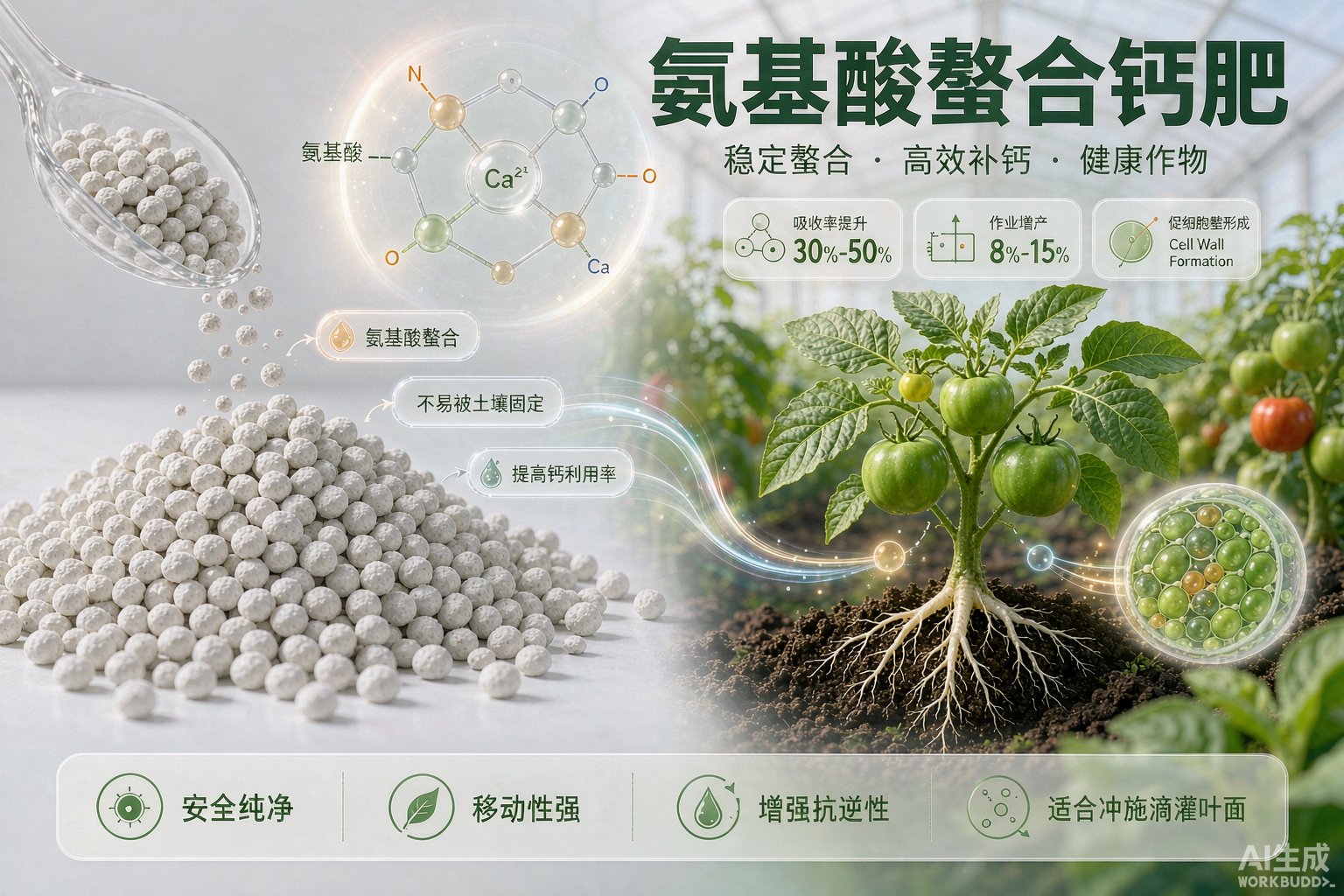
What is Amino Acid Chelated Calcium Fertilizer?
Amino acid chelated calcium fertilizer is an organic nutrient where calcium ions are bound to amino acids (often from hydrolyzed proteins like soy). This chelation process creates a stable, protected form of calcium that plants absorb more easily than traditional inorganic sources like calcium nitrate or chloride.
It typically comes as a light yellow, water-soluble powder or liquid, with compositions like 10-15% chelated calcium and 25-30% amino acids. It’s designed for foliar sprays, soil application, or fertigation.
Key Benefits
- Superior Absorption and Mobility: Plants take up chelated calcium efficiently via roots and leaves. University trials show 92% absorption efficiency vs. 15-40% for calcium nitrate, as amino acids act as natural carriers.
- Prevents Calcium Deficiencies: Effectively combats issues like blossom-end rot (tomatoes/peppers), bitter pit (apples), tip burn (lettuce), and fruit cracking.
- Strengthens Plant Structure: Calcium builds strong cell walls, improving firmness, shelf life (up to 8-12 days longer), and resistance to diseases/stress.
- Enhances Overall Nutrition: Amino acids boost uptake of other nutrients (e.g., potassium), promote root growth, and stimulate microbial activity in soil.
- Organic and Environmentally Friendly: Biodegradable, low/no nitrate or chloride, reduces salinity risks compared to inorganic options.
- Yield and Quality Improvements: Studies on apples, potatoes, and artichokes show increased fruit weight, firmness, and nutrient content.
Comparison to Traditional Calcium Fertilizers (e.g., Calcium Nitrate)
| Aspect | Amino Acid Chelated Calcium | Calcium Nitrate |
| Absorption Efficiency | High (up to 92%, rapid foliar/soil uptake) | Lower (15-40%, prone to lockup in soil) |
| Mobility in Plant | Excellent (amino acids transport Ca inside) | Limited (Ca is immobile once applied) |
| Risk of Salinity/Burn | Low (organic, no chloride/nitrate buildup) | Higher (can increase soil EC) |
| Additional Benefits | Provides amino acids for growth stimulation | Primarily Ca + N (may cause excessive veg growth) |
| Environmental Impact | Biodegradable, soil-friendly | Potential nitrate leaching |
| Best For | Deficiency correction, quality focus | Quick Ca boost in nitrogen-needy crops |
Chelated forms outperform in preventing disorders and improving quality, especially in high-value crops like fruits and vegetables.
Popular Products
- Biomin Calcium — Liquid, 5% Ca, fully bioavailable.
- Cal-Mino — Powder from soy hydrolysate, low nitrate.
- Metalosate Calcium (Balchem) — Amino acid-based for foliar use.
- HUMICO/HumxAmino Ca — Powder with 10-15% Ca.
- Combinations like Ca + Boron or Ca-Mg for broader nutrition.
Application Tips
- Foliar Spray: Dilute 800-1000x, apply during flowering/fruiting.
- Soil/Drip: 3-5 kg/ha, multiple applications.
- Ideal for tomatoes, peppers, apples, leafy greens, and greenhouse crops.
This fertilizer is a premium choice for efficient, organic calcium supplementation in modern agriculture.
What is Chelation in Amino Acid Chelated Calcium?
Chelation is a chemical process where a metal ion (here, calcium Ca²⁺) is bound to a ligand (amino acids or peptides) forming a stable, ring-like structure called a chelate. This “claw-like” grip (from Greek chele meaning claw) protects the calcium from reacting with soil anions (e.g., phosphates, sulfates) that cause precipitation or lockup.
In amino acid chelated calcium fertilizers, the calcium is typically bound to 1-3 amino acid molecules (often 2 for stability), creating a neutral or near-neutral complex that’s highly soluble and bioavailable to plants.
Mechanism of Chelation
- Binding Sites: Calcium primarily coordinates with the carboxyl group (-COO⁻) and amino group (-NH₂) of amino acids, forming coordinate bonds. Side chains (e.g., in aspartic or glutamic acid) can provide additional oxygen donors for stronger chelation.
- Stoichiometry: Per AAFCO standards, 1 mole of Ca²⁺ binds to 1-3 (preferably 2) moles of amino acids, resulting in a molecular weight under ~800 Da for optimal absorption.
- Stability: The ring structure (often 5- or 6-membered) increases entropy and stability compared to simple salts, preventing dissociation in varying pH conditions.
- Why Better for Plants: The chelate mimics natural plant transport mechanisms—amino acids carry calcium across cell membranes via peptide transporters, making it xylem- and phloem-mobile (unlike inorganic Ca, which is mostly immobile).
Production Process
Commercial amino acid chelated calcium is produced via controlled chemical reaction:
- Source Materials:
- Amino acids/peptides: Often from enzymatic hydrolysis of proteins (e.g., soy, whey, or animal sources) to yield free amino acids or short peptides.
- Calcium source: Soluble salts like calcium chloride (CaCl₂), calcium nitrate (Ca(NO₃)₂), or calcium hydroxide (Ca(OH)₂).
- Reaction Steps:
- Dissolve calcium salt in water.
- Add hydrolyzed amino acids/peptides under controlled temperature (40-80°C) and pH (often alkaline to deprotonate carboxyl groups).
- Stir vigorously to facilitate coordination—reaction is exothermic and forms the chelate complex.
- Sometimes auxiliary agents (e.g., citric acid, sorbitol) are added for stability or liquidity.
- Cool, purify (remove unreacted ions), and dry (spray-drying or granulation) to powder or liquid form.
- Advanced Methods:
- High-pressure homogenization or sonication for better chelation rates (>85%).
- Ensured chelation verified by FTIR spectroscopy or ICP-MS.
Key Advantages of the Chelation Process
| Aspect | Inorganic Calcium (e.g., CaNO₃) | Amino Acid Chelated Calcium |
| Stability in Soil | Prone to fixation/precipitation | Highly stable, resists lockup |
| Plant Uptake | Passive, limited mobility | Active transport via amino carriers |
| Absorption Efficiency | 15-40% | Up to 90%+ |
| pH Tolerance | Narrow range | Wide (effective in alkaline soils) |
| Environmental Impact | Risk of leaching/nitrate buildup | Biodegradable, low salinity |
This process makes amino acid chelated calcium a superior, organic-compatible option for correcting deficiencies and boosting crop quality without the drawbacks of traditional sources.
Frequently Asked Questions: Amino Acid Chelated Calcium Fertilizer
1. What is amino acid chelated calcium fertilizer?
It is a highly bioavailable form of calcium where calcium ions are bound (chelated) to amino acids or short peptides, typically from hydrolyzed plant proteins like soy. This creates a stable, organic complex that plants absorb much more efficiently than traditional calcium sources.
2. How does the chelation process work?
Calcium binds to the carboxyl (-COO⁻) and amino (-NH₂) groups of amino acids, forming stable ring structures. This protects calcium from soil reactions and allows active transport into plant cells via amino acid carriers.
3. What are the main benefits?
- Prevents calcium deficiencies like blossom-end rot in tomatoes, bitter pit in apples, and tip burn in lettuce.
- Strengthens cell walls for better fruit firmness and longer shelf life (8-12 days extension).
- Improves nutrient uptake, root growth, and stress resistance.
- Biodegradable and low salinity risk.
4. How does it compare to calcium nitrate?
| Feature | Amino Acid Chelated Calcium | Calcium Nitrate |
| Absorption Rate | Up to 92% | 15-40% |
| Mobility in Plant | High (phloem-mobile via amino carriers) | Low (mostly immobile) |
| Soil/Salinity Impact | Low risk, biodegradable | Higher salinity, nitrate leaching risk |
| Additional Nutrients | Provides amino acids for growth stimulation | Adds nitrogen (may cause excess vegetation) |
| Best For | Quality focus, deficiency prevention | Quick Ca + N boost |
Chelated forms excel in efficiency and environmental safety.
5. Is it organic or suitable for organic farming?
Many products (e.g., from soy hydrolysate) are OMRI-listed or organic-compatible, with no nitrates or chlorides. Check specific certifications.
6. How should I apply it?
- Foliar spray: Most effective—dilute and apply during flowering/fruiting for rapid uptake.
- Soil/drip: 3-5 kg/ha, multiple applications.
- Timing: Best during high-demand periods (fruit set, rapid growth).
7. Can it be mixed with other fertilizers or pesticides?
Yes, generally compatible, but test for tank-mix stability. Avoid extreme pH mixtures.
8. Is it safe for the environment and soil?
Highly—biodegradable, reduces salinity buildup, and supports soil microbes compared to inorganic options.
9. What crops benefit most?
Fruits (tomatoes, peppers, apples), vegetables (lettuce, potatoes), and greenhouse crops prone to calcium disorders.
10. Are there any drawbacks?
Higher cost than basic calcium sources, but offset by better efficiency and reduced application needs.
This fertilizer is ideal for modern, sustainable agriculture focusing on quality and yield optimization.
Interested in JINGFENG’s amino acid products? Explore our full range of high-quality biostimulants and organic fertilizers.

Leave a Comment
Your email address will not be published. Required fields are marked *