





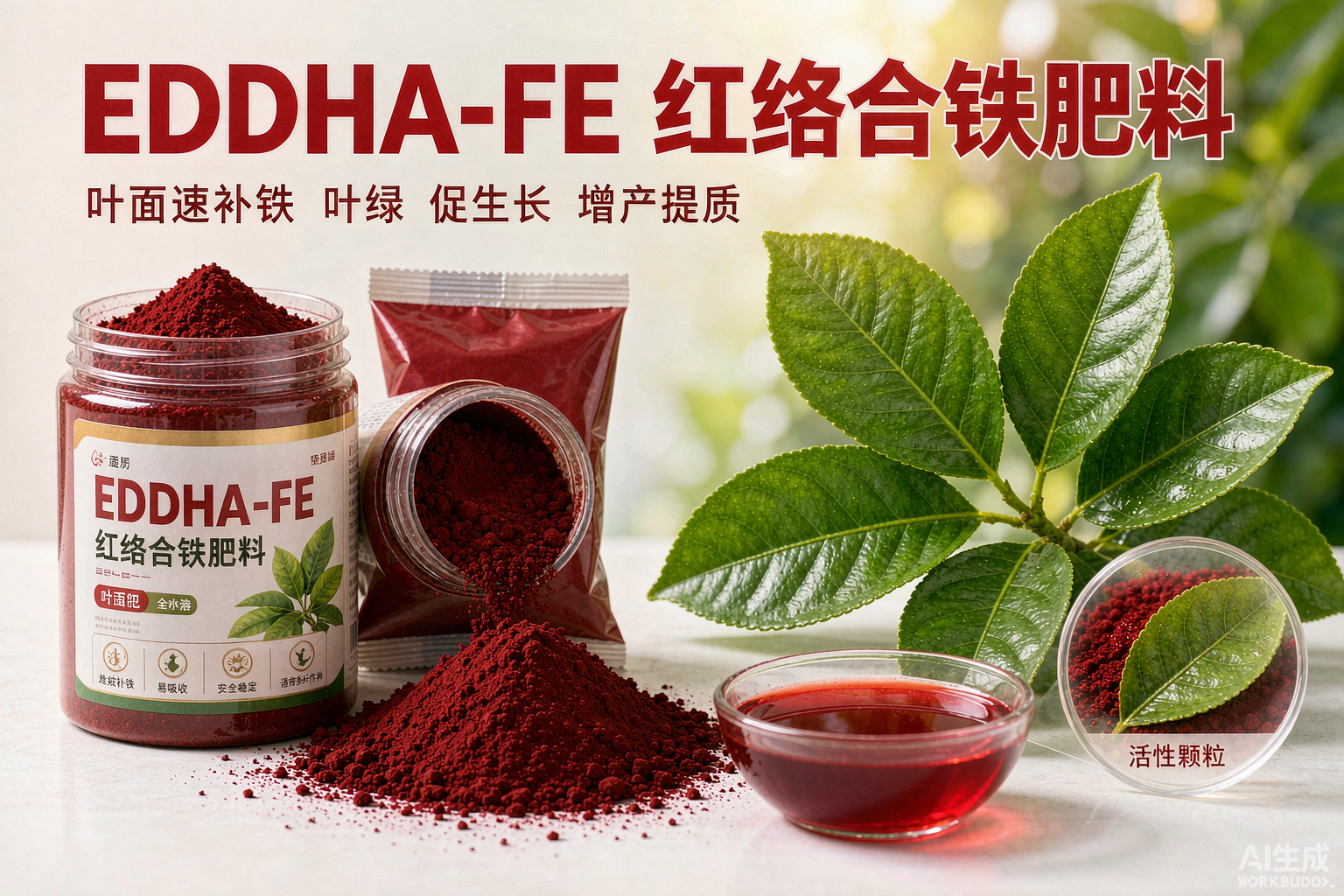
EDDHA-Fe 6% is a high-efficiency chelated iron fertilizer renowned for its exceptional stability in alkaline environments. Unlike conventional iron fertilizers, it resists fixation by soil ions and maintains iron bioavailability even in harsh soil conditions, making it a go-to solution for addressing iron deficiency in crops. Below is a detailed guide tailored to English-speaking audiences, covering its suitable crops, key application scenarios, and critical parameter selection criteria.
1. Suitable Crop Types
EDDHA-Fe 6% is compatible with all iron-demanding crops, with particularly notable effects on crops grown in alkaline soils or inherently sensitive to iron deficiency. It can be categorized by crop type as follows:
Fruit Trees: Citrus, apples, pears, grapes, kiwifruit, cherries, mangoes, bananas, etc. It is especially ideal for fruit trees in northern alkaline soil orchards or protected cultivation (iron deficiency often causes leaf chlorosis).
Vegetables: Tomatoes, cucumbers, peppers, eggplants, strawberries, lettuce, broccoli, celery, etc. Strawberries and tomatoes are highly sensitive to iron deficiency, which can exacerbate issues like blossom end rot.
Field Crops: Corn, wheat, rice, cotton, soybeans, etc. Primarily used in alkaline soils (pH > 7.5) or continuous cropping fields (long-term cultivation depletes soil iron).
Flowers and Seedlings: Ornamental flowers such as roses, chrysanthemums, lilies, and orchids, as well as seedlings like poplars and willows. Iron deficiency leads to leaf chlorosis, reducing ornamental value and growth vitality.
Special Crops: Blueberries (acid-loving plants that require mandatory iron supplementation when grown in alkaline soils) and Chinese medicinal herbs (e.g., ginseng, wolfberries—iron deficiency impairs the accumulation of active ingredients).
Core Principle: The higher a crop’s iron demand and the higher the soil pH, the more significant the effects of EDDHA-Fe 6%.
2. Key Application Scenarios
2.1 Soil Condition-Driven Scenarios
Alkaline Soils (pH 7.0-9.0): This is the primary application scenario. Ordinary iron fertilizers (e.g., EDTA-Fe) are easily fixed by calcium and magnesium ions in soil when pH > 7.0, while EDDHA-Fe retains iron activity through chelation, with a utilization rate 3-5 times higher than conventional iron fertilizers.
High Calcium-Magnesium Soils: Soils with excessive calcium and magnesium (e.g., calcareous soils) form insoluble compounds with iron. EDDHA-Fe avoids this reaction, ensuring iron is absorbed by crops.
Continuous Cropping/Protected Cultivation Soils: Long-term continuous cropping (e.g., greenhouse vegetables) causes soil nutrient imbalance and pH elevation, increasing iron deficiency risk. EDDHA-Fe can be used as a base or topdressing to supplement iron.
2.2 Crop Demand-Driven Scenarios
When Iron Deficiency Symptoms Appear: Manifested as “interveinal chlorosis” (green veins with yellowing mesophyll), which progresses to leaf whitening and necrosis in severe cases. For emergency correction, a combination of foliar spraying and soil drenching yields the best results.
Critical Crop Growth Stages: Flowering and fruiting stages of fruit trees, seedling and fruit expansion stages of vegetables, jointing and booting stages of field crops. Iron deficiency during these periods directly impacts yield and quality, so proactive supplementation is recommended.
Enhancing Crop Stress Resistance: Iron deficiency weakens photosynthesis and immunity. Applying EDDHA-Fe before stress events (e.g., drought, low temperatures) boosts stress tolerance and minimizes yield losses.
2.3 Fertilization Method-Adapted Scenarios
Drip Irrigation/Sprinkler Irrigation: Suitable for large-scale crops (e.g., field crops, protected vegetables). EDDHA-Fe 6% has excellent water solubility (≥60g/L), allowing uniform application with water directly to the root zone.
Foliar Spraying: Ideal for emergency iron supplementation (e.g., chlorotic leaves) or scenarios where soil fertilization is inconvenient (e.g., seedlings, fruit trees). Diluted sprays are quickly absorbed, with visible greening within 3-5 days.
Soil Base Dressing/Furrow Application: Suitable for perennial crops like fruit trees and seedlings. Applied with base fertilizers, it releases iron slowly to meet long-term growth needs.
3. Critical Parameter Selection Criteria
Selecting EDDHA-Fe 6% requires focusing on “active ingredients, compatibility, and usability.” Below are key parameters and their selection logic:
3.1 Core Active Parameter: ortho-ortho Isomer Content
This is the most critical indicator of EDDHA-Fe effectiveness, as the ortho-ortho structure serves as the primary carrier of bioavailable iron. Higher content means stronger iron utilization:
High ortho-ortho content (4.8%): Suitable for soils with pH > 8.0, severe iron deficiency, or high iron-demand crops (e.g., strawberries, citrus). It delivers fast iron supplementation and a long residual effect (2-3 months).
Standard ortho-ortho content (3.6%): Ideal for soils with pH 7.0-8.0, mild iron deficiency, or preventive applications. It offers better cost-effectiveness for regular iron supplementation in field crops.
3.2 Basic Quality Parameters: Purity and Impurity Control
Chelated Iron (Fe) Content: Must be ≥6.0% (dry weight basis). Contents below this standard result in insufficient iron supplementation—always verify with third-party test reports.
Heavy Metal Limits: Lead (Pb) ≤ 30ppm and Cadmium (Cd) ≤ 5ppm, complying with EU and Chinese agricultural standards to avoid heavy metal accumulation in crops (especially fruits and vegetables).
Water Solubility: ≥60g/L (20℃). Poor water solubility can clog drip irrigation systems—prioritize products labeled “100% water-soluble.”
3.3 Application Compatibility Parameters: pH and Mixability
pH of 1% Aqueous Solution: 7.0-9.0. This range ensures compatibility with most NPK fertilizers and pesticides. Conduct a small-scale compatibility test before tank mixing to prevent inactivation due to acid-base reactions.
Form Selection: Powdered forms are suitable for soil applications (easily dissolved in water for drenching/drip irrigation), while liquid forms are preferred for foliar spraying (uniform dispersion and higher absorption efficiency). Choose based on your fertilization method.
Conclusion
EDDHA-Fe 6%’s effectiveness hinges on aligning crop needs, soil conditions, and product parameters. By selecting the right ortho-ortho content, ensuring quality compliance, and matching the product form to your fertilization method, you can efficiently address iron deficiency and enhance crop yield and quality.
Interested in JINGFENG’s our application guides products? Explore our full range of high-quality biostimulants and organic fertilizers.
Leave a Comment
Your email address will not be published. Required fields are marked *