





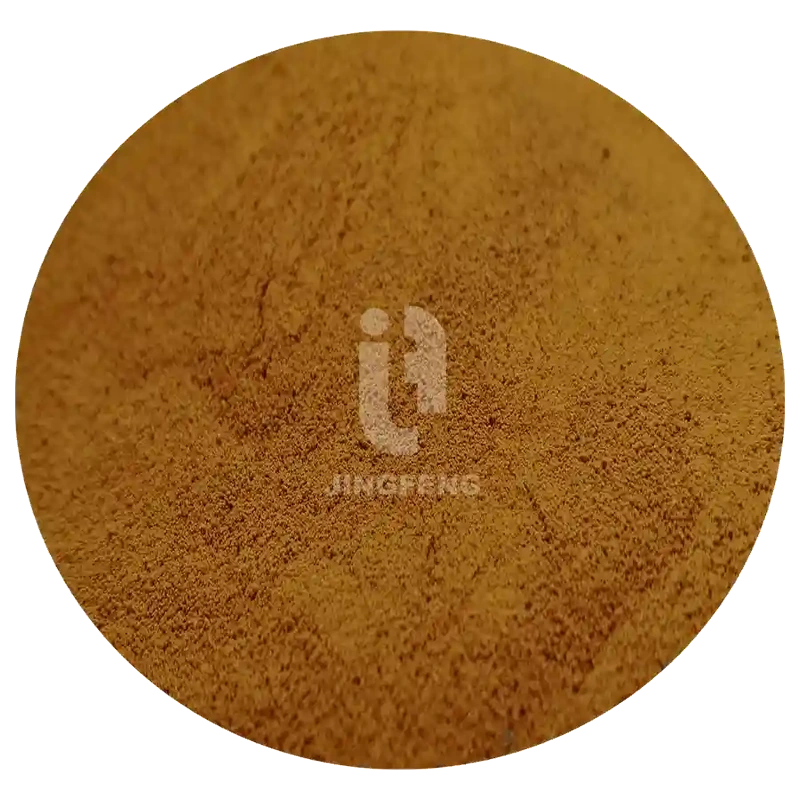
Bio Fulvic Acid Powder 70%
More Fulvic Per Tonne — The Higher-Active Powder Grade
Every lot ships with a Certificate of Analysis stating actual tested values.
Product Overview
Bio Fulvic Acid is JINGFENG’s biotech-fermented fulvic acid — produced by microbial fermentation of plant-derived feedstock rather than mined from leonardite. It is a short-chain humic substance rich in fulvic acid, free amino acids, enzymes, sugars and trace nutrients. Fully water soluble and hormone-free, it is used worldwide as a fertilizer raw material and plant biostimulant — chelating nutrients, buffering soil pH, and improving nutrient uptake in foliar, fertigation and blending programmes.
Bio Fulvic Acid Powder 70% is the higher-active sibling of our 50% grade, carrying 70% fulvic acid and 12% K₂O on a dry basis while keeping the same 100% water solubility and 32 meq/g anti-flocculation limit. It is the grade to choose when the fulvic content on your label is the selling point and you want to hit a higher guarantee per kilogram of product.
Built for premium compound blends, soluble retail packs and high-value foliar programmes, the 70% powder meters and dissolves like the 50% grade but delivers more short-chain active carbon per unit. Fermentation-derived amino acids, enzymes and sugars ride along, so the agronomic effect is broader than a plain humate salt.
Trade-off, stated plainly: the higher fulvic load means a slightly higher price per tonne. If you are a blender watching cost per tonne, the 50% grade is the better value; if you are a formulator claiming a high fulvic number, this is your grade.
Key Benefits
70% fulvic acid
The higher-active powder in the family — more short-chain carbon per kilogram for labels that lead on fulvic content.
Fermented, not mined
Carries free amino acids, enzymes and sugars; hormone-free green bio-input.
100% soluble, hard-water stable
Dissolves with no residue; anti-flocculation limit 32 meq/g holds in calcareous and saline irrigation.
Blends and dissolves cleanly
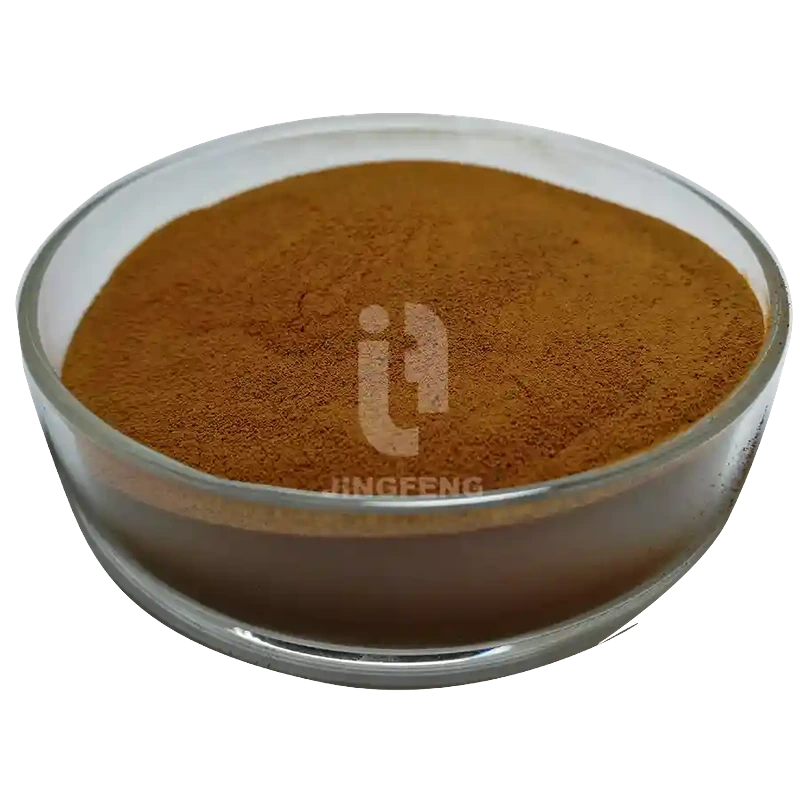
Fine brown powder that disperses evenly and wets out in seconds under light agitation.
Chelates and buffers
Complexes metal ions, frees fixed phosphorus, buffers soil pH toward 5.5–7.0.
COA on every batch
Tested fulvic acid, K₂O, pH and moisture against HG/T and NY/T methods, stated on the COA.
Technical Specification
| Parameter | Specification | Test standard |
|---|---|---|
| Appearance | Brown powder | Visual inspection |
| Fulvic acid (dry basis) | ≥ 70.0% | HG/T 5334-2018 |
| Potassium as K₂O (dry basis) | ≥ 12.0% | NY/T 1977 |
| Water solubility | 100% | NY/T 1978 |
| pH (1:100) | 4.0 – 6.0 | HG/T 3278 |
| Moisture | ≤ 2.0% | GB/T 8576 |
Specification values are guaranteed minimums on a dry basis, taken from the batch Certificate of Analysis and tested against the stated Chinese industry standards. Every shipment travels with its own COA stating the tested values.
Need the full Certificate of Analysis, MSDS, or TDS for your formulation or tender file?
Request COA / MSDS / TDSForm & Solubility
Form: free-flowing brown powder, slightly finer and darker than the 50% grade because of the higher active load.
In water: wets out on contact and disperses within seconds under light agitation. Add onto moving water to avoid a surface crust.
Dust: some dust at the weighing station — standard PPE and local extraction recommended.
Which powder? 70% when fulvic content per tonne is the priority; 50% when cost per tonne is the priority. Both dissolve and blend the same way.
How Bio Fulvic Acid grades compare
| Grade | Form | Fulvic acid | Key element | K₂O | Best for |
|---|---|---|---|---|---|
| Bio Fulvic Acid Powder 50% | Powder | ≥ 50% | — | ≥ 12% | Standard blending & foliar base |
| Bio Fulvic Acid Powder 70% (this product) | Powder | ≥ 70% | — | ≥ 12% | Higher-active powder |
| Bio Fulvic Acid Powder 90% | Powder | ≥ 90% | — | — | Concentrated / high-fulvic label |
| Bio Fulvic Acid Chelate Calcium | Powder | ≥ 45% | Ca ≥ 8% | — | Correct Ca deficiency |
| Bio Fulvic Acid Chelate Iron | Powder | ≥ 15% | Fe ≥ 14% | — | Correct Fe chlorosis |
| Bio Fulvic Acid Chelate Zinc | Powder | ≥ 15% | Zn ≥ 10% | — | Correct Zn deficiency |
| Bio Fulvic Acid Chelate Manganese | Powder | ≥ 24.86% | Mn ≥ 13% | — | Correct Mn deficiency |
| Bio Fulvic Acid Chelate Magnesium | Powder | ≥ 21.54% | Mg ≥ 10% | ≥ 3.48% | Correct Mg deficiency |
| Bio Fulvic Acid Round Granule | Granule | ≥ 52.3% | — | ≥ 10.42% | Dust-free spread or dissolve |
All grades are fermented, 100% water soluble and stable in hard/saline water (anti-flocculation 32 meq/g).
Applications & Dosage
| Application | How to use | Rate |
|---|---|---|
| Premium compound / bulk-blended NPK | Add 5–10 kg per tonne for a high-fulvic claim on the spec sheet. | 5–10 kg/t |
| High-value water-soluble formula | Use as the fulvic base at 5–10% of total solids; compatible with MAP, MKP and chelates. | 5–10% of formula |
| Foliar spray | Dilute 1:1000–1:1500; spray every 7–15 days. | 0.2–0.5 kg/mu |
| Drip / fertigation | Pre-dissolve, filter, then meter into the line. | 0.5–1.0 kg/mu |
| Seed soaking / root dip | 1:500–1:800 solution, soak 6–12 h. | 1:500–1:800 |
Packaging & Storage
| Pack size | Description |
|---|---|
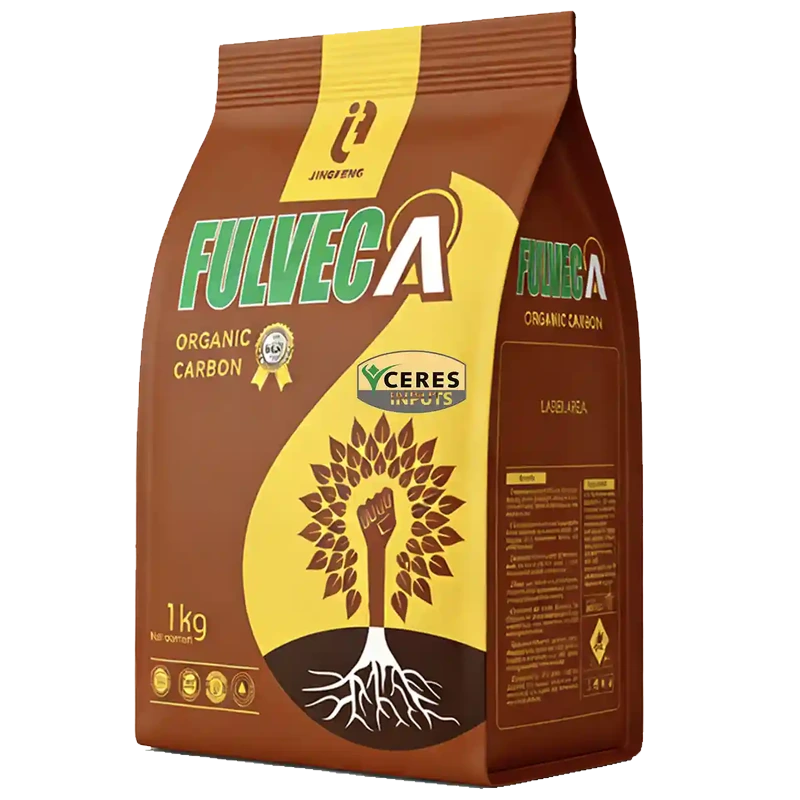
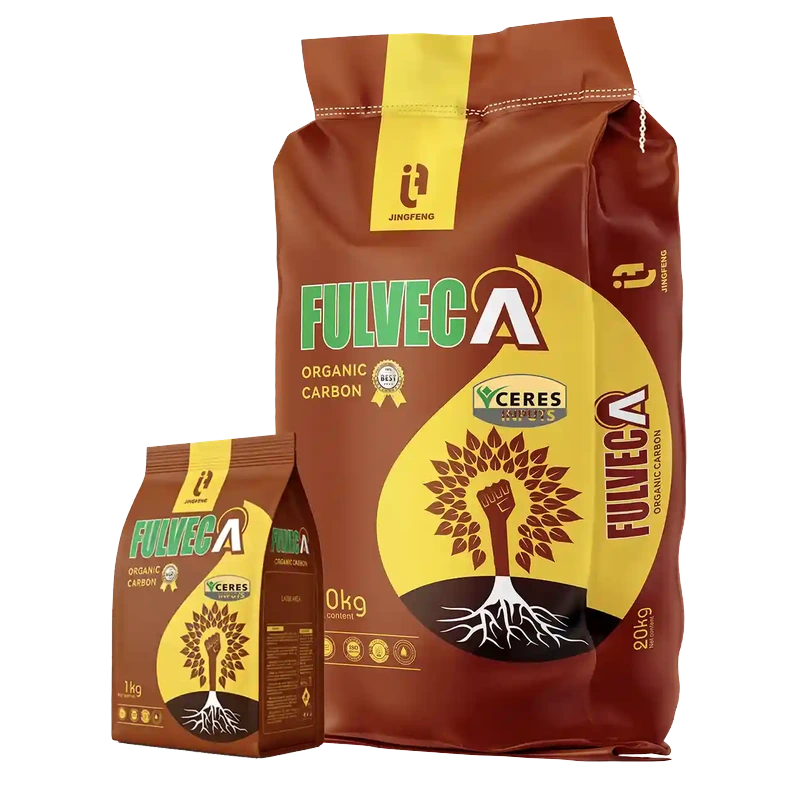
| 1 kg / 5 kg / 10 kg | Printed aluminium foil bag — retail and sample size |
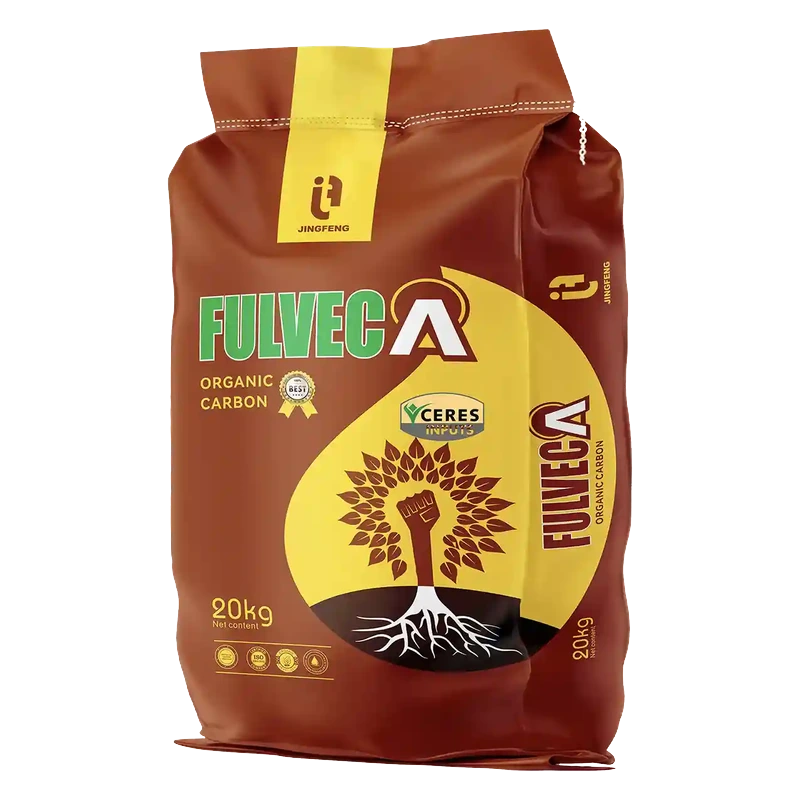
| 20 kg / 25 kg | Woven or paper bag with inner PE liner |
| 1000–1100 kg | Jumbo bag with discharge spout |
Storage: Store in a cool, dry, well-ventilated place and reseal opened bags. The powder is hygroscopic; under proper storage it is stable for 2 years.
Custom packaging, private-label printing and OEM specifications are available on request. Packaging photos are available in the product gallery.
Successful Cases
Premium soluble brand, Italy
Built a high-fulvic retail soluble pack around the 70% grade; the fulvic guarantee became the headline claim on the label.
Explore applications → Field referenceCompound NPK plant, Shandong
Replaced a 50% fulvate with the 70% grade at 8 kg/t to raise the listed humic/fulvic content without changing the process.
Explore applications → Field referenceTomato greenhouse cluster, Mexico
0.8 kg/mu per cycle on calcareous soil; firmer fruit and lower blossom-end rot recorded.
Explore applications →Full case studies with crop data are published in our application sectors.
Frequently Asked Questions
Why choose 70% over 50%?
The 70% grade delivers more fulvic acid per kilogram, so you hit a higher label guarantee with less product. You pay more per tonne for that. If cost per tonne dominates, the 50% grade is the better value.
Is it still 100% soluble?
Yes. Both grades dissolve completely with light agitation and leave no residue in tank or dripper.
Can it be blended with urea or DAP?
Yes, at 5–10 kg per tonne through the normal blending cycle; separation during transport is minimal.
Is it stable in hard water?
Yes — anti-flocculation limit 32 meq/g, soluble across pH 1–14 and in saturated brine.
What is the minimum order and lead time?
Stock item. MOQ one pallet; 7–15 days ex-works. Custom print and private label available.
Do you supply a COA per batch?
Yes — fulvic acid, K₂O, pH and moisture tested to HG/T and NY/T methods.
Need a quotation or a sample?
Tell us your application, target market and packaging — we will come back with specification, price and lead time.
Request a Quote
 8618920222224