






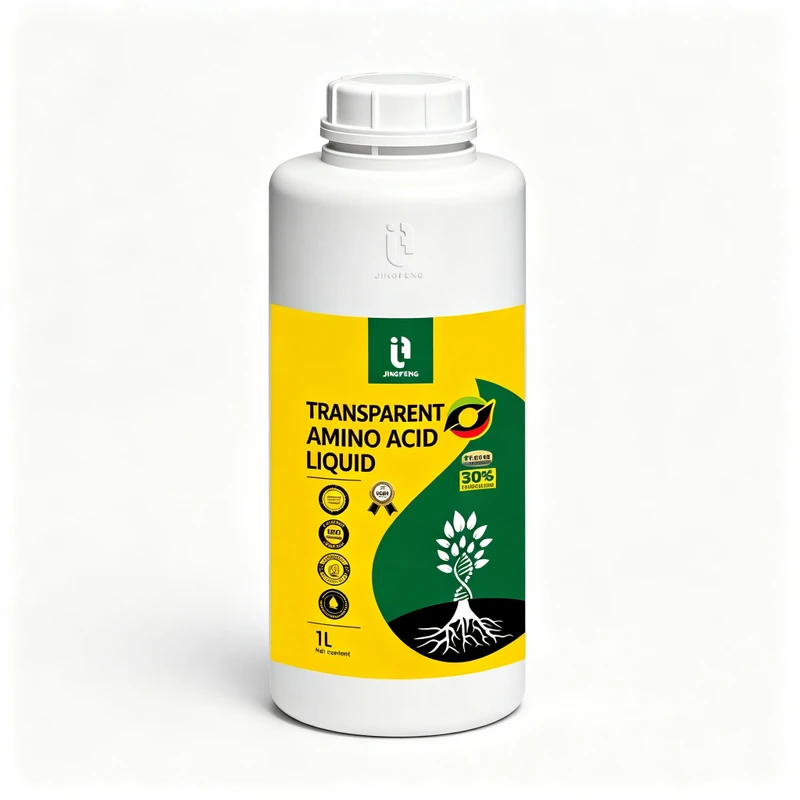
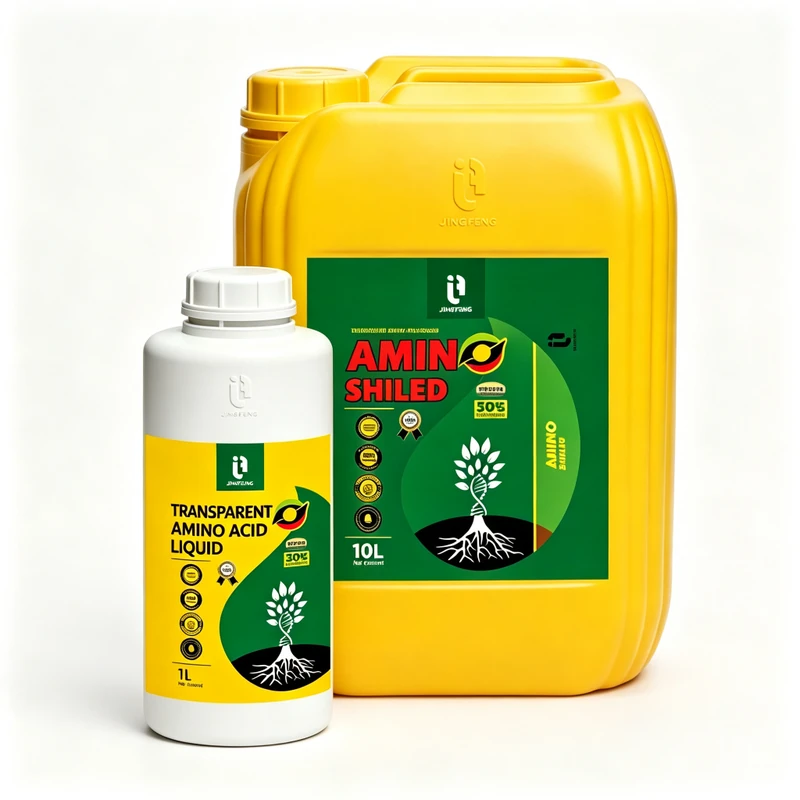
Transparent Amino Acid Liquid 30%
Clear Solution — 300 g/L Amino Acids at 0.3% Chloride
Every lot ships with a Certificate of Analysis stating tested total amino acids, free amino acids, total nitrogen and chloride.
Product Overview
Amino acids are the building blocks of proteins and, in free form, the most readily absorbed nitrogen source a plant or an animal can take up. JINGFENG’s amino acid range is produced from plant protein (soybean) or animal protein by acid or enzymatic hydrolysis, which breaks the protein chain down into free amino acids, short peptides and water-soluble nitrogen. The result is a 100% water-soluble input used as a foliar and fertigation biostimulant, a chelating agent for trace elements, and a feed-grade protein source.
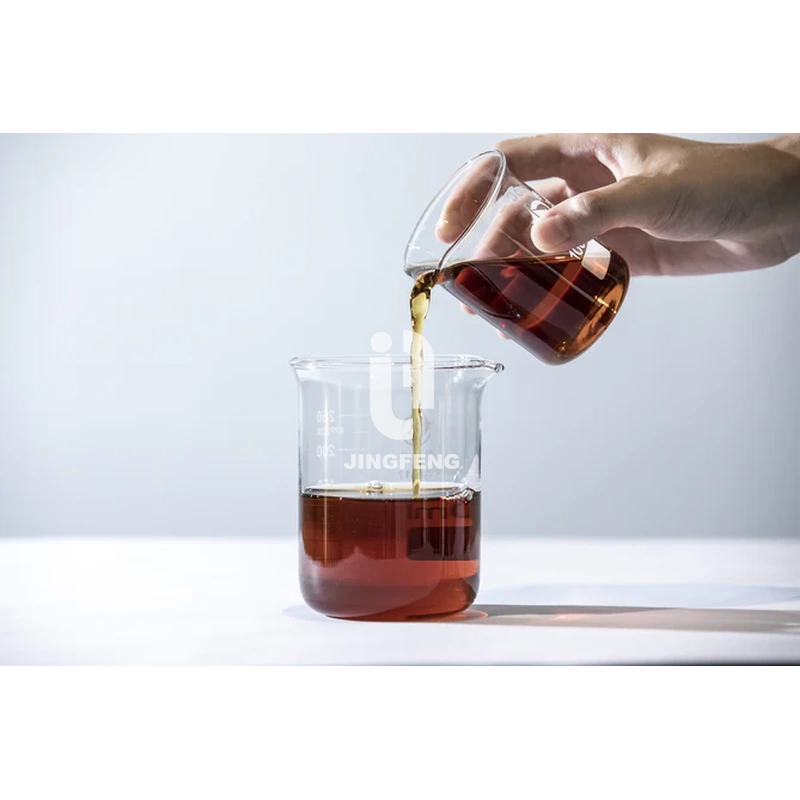
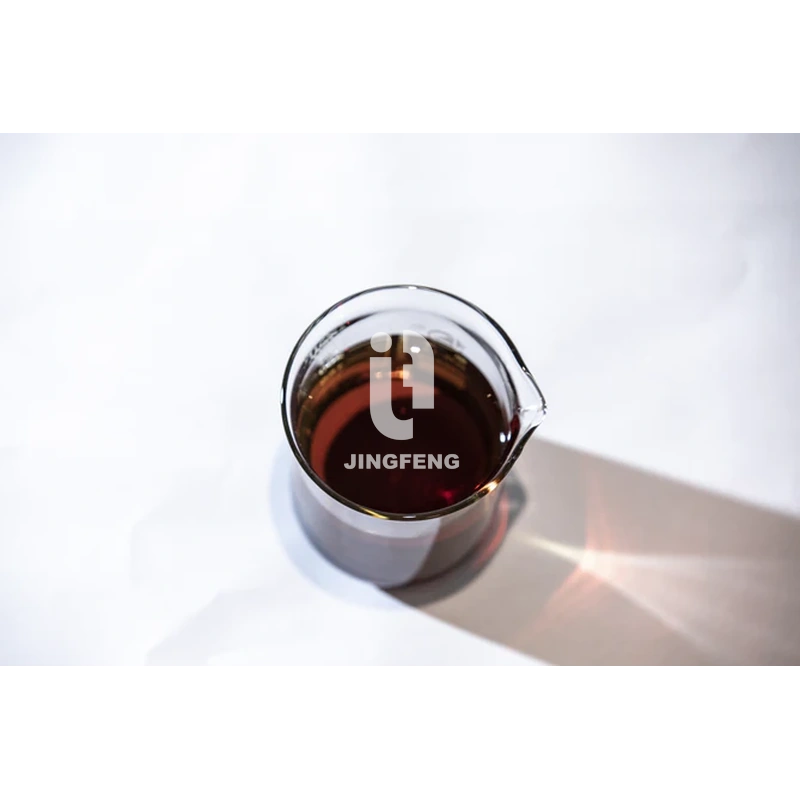
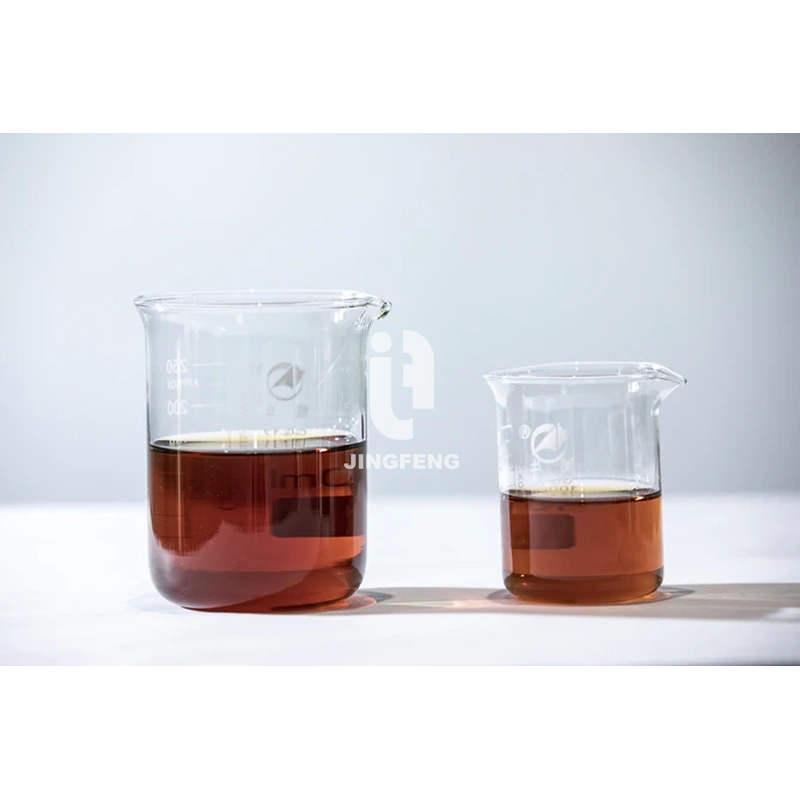
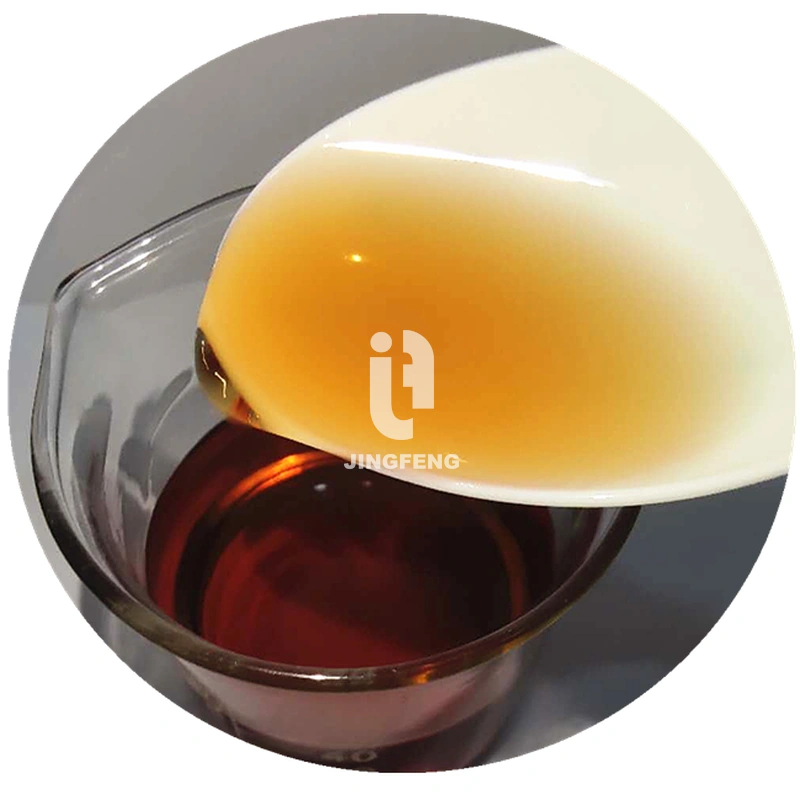
Transparent Amino Acid Liquid 30% is the fully refined grade of our liquid range. Further clarification removes the suspended solids that make a standard hydrolysate opaque, and what is left is a clear, light brown liquid carrying ≥ 300 g/L of amino acids with ≥ 7% total nitrogen.
Two things follow from that. The first is practical: because the liquid is transparent you can see at a glance whether it has fully dissolved in the tank — no cloudiness means no undissolved residue, which is what blocks spray nozzles and drippers. The second is agronomic: chloride is held to ≤ 2%, and production lots run far below that ceiling, so the product is safe on chloride-sensitive crops where a standard hydrochloric-acid hydrolysate is not.
It is used across vegetables, fruit, grain and protected crops, on its own or blended with macro-, secondary- and micronutrients, and it raises tolerance to cold, heat, drought and waterlogging.
Key Benefits
≥ 300 g/L total amino acids
A clear, fully refined liquid: at least 300 g of amino acids per litre, with chloride held to ≤ 2% — low enough for strawberries, tobacco and grapes.
No dissolving step
Supplied ready to dilute, which saves a mixing stage in fertigation and spray programmes.
Metering accuracy
A uniform liquid is easy to dose precisely, batch after batch.
High load per litre
Concentrated grades carry a high amino acid load per litre, which keeps freight cost per unit of active down.
Mixes with most inputs
Compatible with common foliar fertilisers and, after a jar test, with many agrochemicals.
COA on every batch
Each lot ships with a Certificate of Analysis stating the tested amino acids, total nitrogen, chloride, density and pH for that batch.
Technical Specification
| Parameter | Specification | Test standard |
|---|---|---|
| Appearance | Light brown liquid | Visual inspection |
| Total amino acid | ≥ 300 g/L | NY/T 1975-2010 |
| Total nitrogen | ≥ 7.0% | NY/T 1977-2010 |
| Chloride (Cl⁻) | ≤ 2.0% | NY/T 1117-2006 |
| Density | 1.19 – 1.20 | GB/T 20886.2-2021 |
| pH | 3.0 – 5.0 | NY/T 1973-2021 |
Specification values are guaranteed minimums on a dry basis, taken from the batch Certificate of Analysis and tested against the stated Chinese industry standards. Every shipment travels with its own COA stating the tested values.
Need the full Certificate of Analysis, MSDS, or TDS for your formulation or tender file?
Request COA / MSDS / TDSForm & Solubility
Form: a concentrated liquid supplied in drums or IBCs, ready to dilute and meter without a dissolving step.
In water: miscible with water in any proportion, so it can be injected straight into a fertigation line or dosed into a spray tank.
Handling: store upright and frost-free. Rinse lines with clean water after use.
Why transparency is worth having. With an opaque hydrolysate you cannot tell whether it has fully dispersed. With this one you can: a clear tank means a clear solution. That removes the most common cause of blocked nozzles and drippers and it makes the application even, which is why growers running intensive greenhouse programmes tend to specify it.
About the chloride. At ≤ 2% — and well below that in practice — it is safe on chloride-sensitive crops such as strawberries, tobacco and grapes. If your programme is on cotton, grain or other tolerant field crops, our concentrated 30% liquid carries more volume efficiency; if chloride has to be near zero, use our salt-free 30% liquid instead.
Handling. Shake gently before use. It may darken slightly over time as the amino acids oxidise; that does not reduce the nutrient content or the effect.
How the amino acid grades compare
| Grade | Form | Total amino acid | Free amino acid | Total nitrogen | Best for |
|---|---|---|---|---|---|
| Amino Acid Chelated Trace Elements Liquid | Liquid | ≥ 200 g/L | — | ≥ 12.0% | Trace element correction plus nitrogen; no dissolving step |
| Amino Acid Chelated Trace Elements Powder 15% | Powder | ≥ 25.0% free | ≥ 25.0% | — | Six chelated trace elements on a free amino acid base |
| Salt-Free Amino Acid Liquid 30% | Liquid | ≥ 300 g/L | — | ≥ 7.0% | Chloride-sensitive crops; foliar and drip |
| Concentrated Amino Acid Liquid 30% | Liquid | ≥ 300 g/L | — | ≥ 7.0% | Field crops and cotton; lowest volume per hectare |
| 30% Hydrolyzed Amino Acid Powder | Powder | ≥ 30.0% | — | ≥ 7.0% | Field-scale foliar, fertigation and liquid fertiliser base |
| Transparent Amino Acid Liquid 30% (this product) | Liquid | ≥ 300 g/L | — | ≥ 7.0% | Low-chloride liquid for strawberry, tobacco and grape |
| 30% Amino Acid Round Granule | Granule | ≥ 30.0% | — | ≥ 7.0% | Machine spreading, NPK blending and seedling substrate |
| 40% Chlorine-Free Amino Acid Powder | Powder | ≥ 40.0% | ≥ 38.0% | — | Strawberry, tobacco and grape; chloride capped at 1% |
| Amino Acid Chelated Calcium and Magnesium Liquid | Liquid | ≥ 400 g/L | ≥ 200 g/L | — | Blossom-end rot, fruit cracking and magnesium chlorosis |
| 45% Hydrolyzed Amino Acid Powder | Powder | ≥ 45.0% | ≥ 40.0% | ≥ 17.0% | High-nitrogen grade; liquid formulations and hydroponics |
| 50% Hydrolyzed Amino Acid Powder | Powder | ≥ 45.0% | ≥ 40.0% | ≥ 15.0% | Cost-efficient foliar and fertigation over large areas |
| Amino Oligosaccharide Peptide Liquid | Liquid | ≥ 500 g/L | ≥ 200 g/L | — | Plant activation; flower and fruit drop and disease pressure |
| 50% Enzymatic Amino Acid Liquid | Liquid | ≥ 500 g/L | 20 – 30 g/L | — | Fertigation and foliar programmes, no dissolving step |
| 60% Hydrolyzed Amino Acid Powder | Powder | ≥ 60.0% | ≥ 55.0% | ≥ 12.0% | General-purpose foliar, drip and flushing |
| 70% Hydrolyzed Amino Acid Powder | Powder | ≥ 70.0% | ≥ 65.0% | ≥ 15.0% amino N | Fast free-amino response at flowering, fruit set and stress recovery |
| 80% Hydrolyzed Amino Acid Powder — Tank-Mix | Powder | ≥ 80.0% | ≥ 75.0% | ≥ 12.5% | Liquid NPK and trace-element compounding |
| 80% Amino Acid Powder — Standard | Powder | ≥ 80.0% | ≥ 75.0% | ≥ 12.5% | Feed premixes, dry blends, straight foliar and soil |
| 80% Enzymatic Amino Acid Powder | Powder | ≥ 80.0% | 3.0 – 5.0% | ≥ 15.0% | Peptide-driven programmes; seed treatment and high-value crops |
| 90% Hydrolyzed Amino Acid Powder | Powder | ≥ 90.0% | ≥ 85.0% | ≥ 15.0% organic N | Premium agriculture, feed and cosmetics |
| 90% Enzymatic Amino Acid Powder | Powder | ≥ 90.0% | ≥ 65.0% | ≥ 16.0% | Peptide-rich; organic and cosmetic specifications |
All grades are 100% water soluble and are hydrolysed from plant- or animal-source protein. Higher grades carry a larger free amino acid share, so less product is needed per hectare for the same response.
Applications & Dosage
For vegetables, fruit, grain and protected crops, and for programmes where tank cleanliness and a low chloride load both matter. Typical rates are 12 to 18 L per hectare as a foliar spray and 20 to 25 L per hectare through drip, with two to three foliar applications per cycle.
| Application | How to use | Rate |
|---|---|---|
| Foliar spray | Spray in the morning or evening at seedling, flowering and fruit expansion. | 1:1000 – 1:1500 |
| Drip irrigation | Meter into the line at seedling and rapid growth, every 7–10 days. | 1:800 – 1:1200 |
| Chloride-sensitive crops | Strawberry, tobacco and grape, where a standard hydrolysate would risk leaf scorch. | 1:1000 – 1:1500 |
| Nutrient compounding | Blend with macro-, secondary- and micronutrients to build a finished formulation. | As formulated |
Packaging & Storage
| Pack size | Description |
|---|---|
| 1 kg / 5 kg / 10 kg | Printed aluminium foil bag |
| 10 kg / 20 kg | Printed carton box |
| 20 / 25 kg | Woven or paper bag with inner liner; colour-printed PP/PE bag with inner liner |
| 200 L drum / 1000 L IBC | For liquid grades; food-grade HDPE drum with tamper-evident closure |
| 1000 / 1100 kg | Jumbo bag with discharge spout |
Storage: Store in a cool, dry, well-ventilated place, away from direct sunlight and moisture. Stable for 24 months in the sealed original packaging; reseal opened bags. Liquid grades: store upright and frost-free.
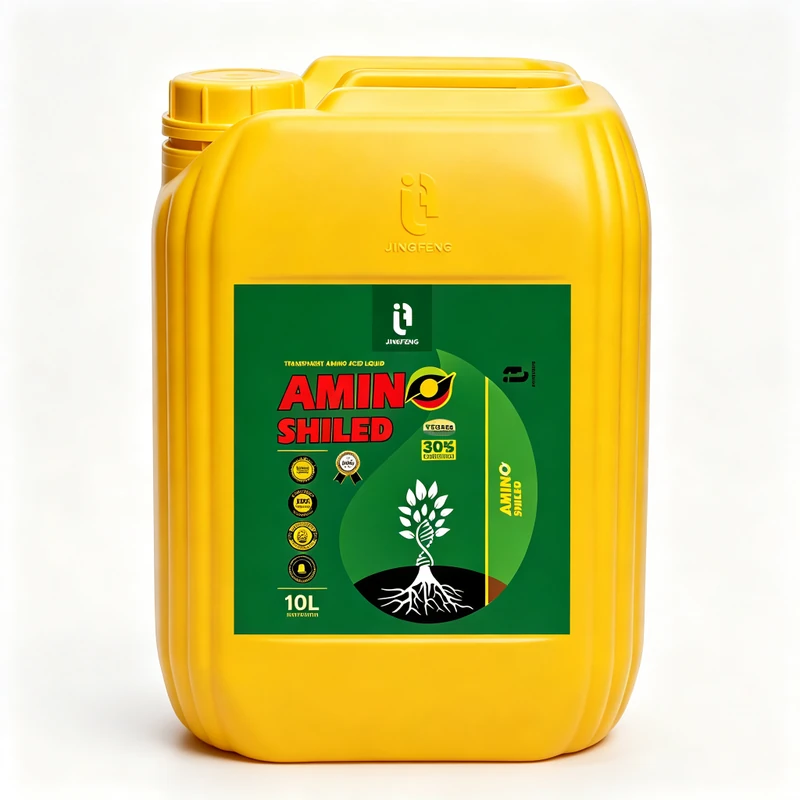
Custom packaging, private-label printing and OEM specifications are available on request. Packaging photos are available in the product gallery.
Successful Cases
Strawberry greenhouse, Hebei (3 ha)
Chloride sensitivity had caused 15% leaf burn and 20% flower drop, and previous high-chloride inputs had hurt quality. Foliar at 1:1200 at bud break and flowering plus one drip at 1:1000 at young fruit: leaf burn eliminated, flower drop down to 4%, fruit averaging 20 g at 11.5 Brix, and yield per hectare up 22%.
Explore applications → Field referenceTomato greenhouse, Zhejiang (4 ha)
Uneven uptake from an opaque product left 12% misshapen fruit and slow seedlings. Foliar at 1:1300 at seedling plus drip at 1:900 at fruit expansion: the transparent formula confirmed full dissolution and misshapen fruit fell to 2%, seedlings came on 3 days earlier and yield rose 19% to 52 tons per hectare.
Explore applications →Full case studies with crop data are published in our application sectors.
Frequently Asked Questions
What is the benefit of a transparent liquid?
You can confirm visually that it has fully dissolved — no cloudiness, no residue. That prevents blocked nozzles and drippers and makes the application uniform, which is the main reason intensive greenhouse programmes specify it.
Why does the low chloride matter?
Chloride causes leaf scorch, lost sweetness and stunted growth on sensitive crops. At ≤ 2% — and well below that in production — this grade can be used on strawberries, tobacco and grapes where a standard hydrochloric-acid hydrolysate cannot.
How does it compare with your other 30% liquids?
Three liquids carry 300 g/L: this one is the refined, low-chloride option; the concentrated 30% liquid is the volume-efficient option for tolerant field crops but carries 9–11% chloride; the salt-free 30% liquid is the one to specify when chloride has to be near zero.
Is it suitable for organic farming?
It is made from natural raw materials with no synthetic additives and is accepted in organic programmes in many markets. Confirm with your certification body for your specific standard.
Can I use it on young seedlings?
Yes. Use the weaker end of the foliar range — about 1:1500 — and test a small area first. Its mild, low-chloride formula lifts seedling vigour without stress or burn.
Can I mix it with pesticides?
It is compatible with most neutral and weakly acidic products. Avoid strongly alkaline inputs above pH 8, and test compatibility with 100 mL of diluted liquid before committing the tank.
How quickly is it absorbed?
The amino acids are small molecules that the crop takes up through roots and leaves within about 24 hours.
How is it packed and what is the minimum order?
200 L drums and 1000 L IBCs as standard, with 1 L, 5 L and 20 L packs for trials; a free 1 L sample is available — you cover the express cost. Bulk MOQ is 500 L, with 5–8% volume discounts above 5000 L. Shelf life is 24 months stored cool, dry and sealed.
Need a quotation or a sample?
Tell us your application, target market and packaging — we will come back with specification, price and lead time.
Request a Quote
 8618920222224