






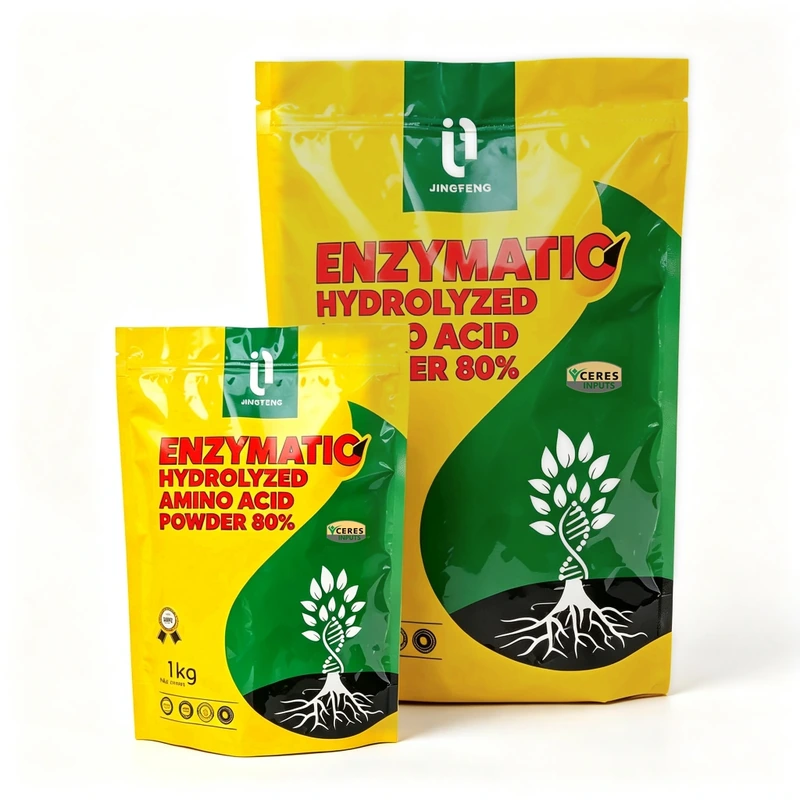
80% Enzymatic Amino Acid Powder
Peptide-Rich Enzymatic Grade — Three Quarters of the Load Held as Peptides
Every lot ships with a Certificate of Analysis stating tested total amino acids, free amino acids, total nitrogen and chloride.
Product Overview
Amino acids are the building blocks of proteins and, in free form, the most readily absorbed nitrogen source a plant or an animal can take up. JINGFENG’s amino acid range is produced from plant protein (soybean) or animal protein by acid or enzymatic hydrolysis, which breaks the protein chain down into free amino acids, short peptides and water-soluble nitrogen. The result is a 100% water-soluble input used as a foliar and fertigation biostimulant, a chelating agent for trace elements, and a feed-grade protein source.
80% Enzymatic Amino Acid Powder is made by controlled enzymatic hydrolysis rather than by acid or alkali. The enzymes cut the protein chain at chosen points, so what comes out is unusually rich in peptides — a guaranteed ≥ 75% — alongside ≥ 80% total amino acids.
Peptides are short chains of amino acids. They are absorbed readily, and they also act as signalling molecules in the plant: they influence gene expression, stress response and growth regulation in ways that single free amino acids do not. That is the practical difference between this grade and a hydrolysed powder of the same strength — the effect lasts longer and travels further through the plant.
The powder is 100% water soluble, very low in moisture, and sits at a pH of 5.0 – 8.0, close to neutral, so it can be brought into a formulation without dragging the pH of the tank.
Key Benefits
≥ 80% total amino acids, ≥ 75% as peptides
Enzymatic hydrolysis keeps the load in peptide form — short chains that plants absorb readily and that also act as signalling molecules for growth and stress response.
Dissolves completely
100% water soluble with no residue, so it can go straight into the spray tank or through a drip line.
High free amino acid share
A large part of the load is in the free form, which plants and animals absorb without further breakdown.
Low chloride option
Low-chloride grades avoid salt burn on chloride-sensitive crops and keep the salt load down in feed rations.
Blend-friendly
A free-flowing powder that disperses evenly into NPK, organic fertilizer and feed premixes, even at low inclusion rates.
COA on every batch
Each lot ships with a Certificate of Analysis stating the tested total amino acids, free amino acids, total nitrogen, chloride and heavy metals against the stated Chinese industry standards.
Technical Specification
| Parameter | Specification | Test standard |
|---|---|---|
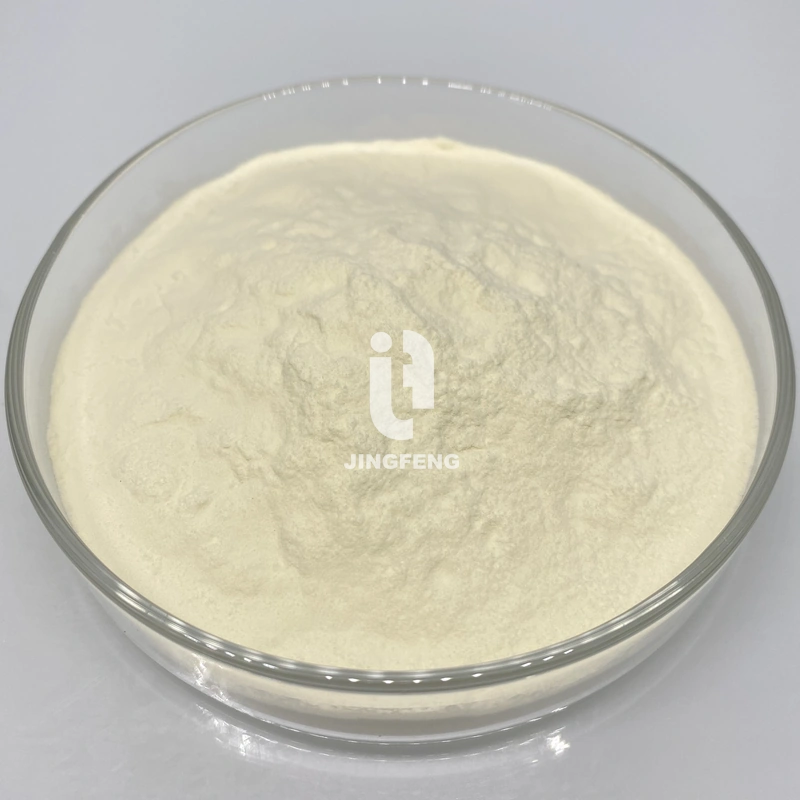
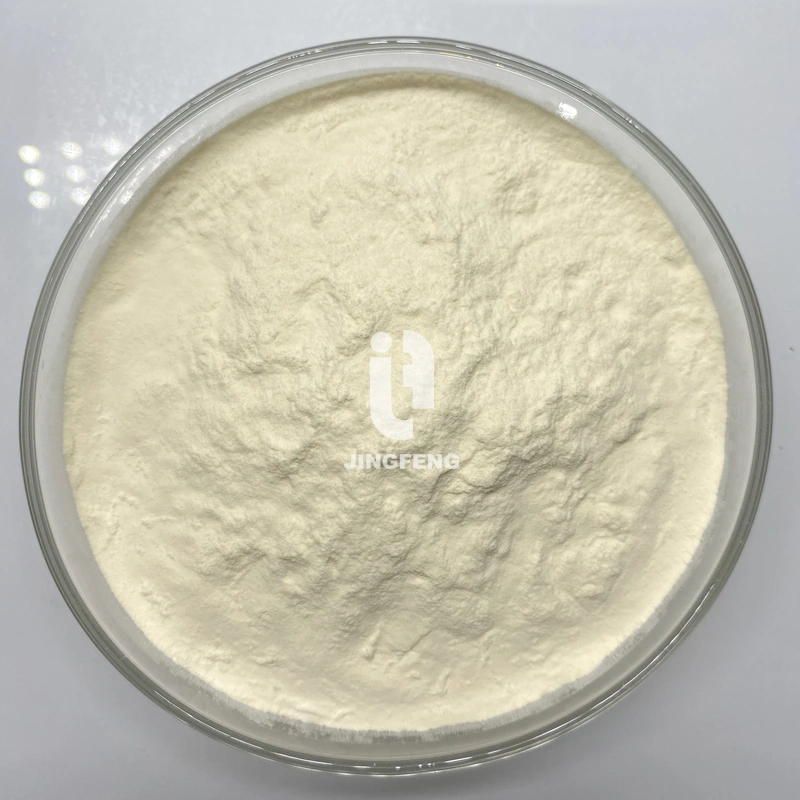
| Appearance | Light yellow powder | Visual inspection |
| Total amino acid | ≥ 80.0% | NY/T 1975-2010 |
| Free amino acid | 3.0 – 5.0% | NY/T 1975-2010 |
| Peptide content | ≥ 75.0% | |
| Total nitrogen | ≥ 15.0% | NY/T 1977-2010 |
| Water solubility | 100% | NY/T 1973-2021 |
| Moisture | ≤ 5.0% | GB/T 6435-2014 |
| pH | 5.0 – 8.0 | NY/T 1973-2021 |
| Lead (Pb) | ≤ 50 ppm | NY/T 1978-2022 |
| Cadmium (Cd) | ≤ 10 ppm | NY/T 1978-2022 |
| Mercury (Hg) | ≤ 5 ppm | NY/T 1978-2022 |
| Arsenic (As) | ≤ 10 ppm | NY/T 1978-2022 |
| Chromium (Cr) | ≤ 50 ppm | NY/T 1978-2022 |
Specification values are guaranteed minimums on a dry basis, taken from the batch Certificate of Analysis and tested against the stated Chinese industry standards. Every shipment travels with its own COA stating the tested values.
Need the full Certificate of Analysis, MSDS, or TDS for your formulation or tender file?
Request COA / MSDS / TDSForm & Solubility
Form: fine, free-flowing powder with low dust, easy to weigh out by the bag and to blend into dry mixes.
In water: 100% water soluble. It wets out quickly and dissolves cleanly under light agitation, leaving no residue to block filters, spray nozzles or drip lines.
Handling: use standard dust protection when handling bulk. Reseal opened bags to keep moisture out.
Molecular weight distribution. The COA for this grade also reports how the peptide fraction sits by molecular weight: roughly 29% falls between 180 and 500 Da and a further 39% between 500 and 1 000 Da, with the balance above 1 000 Da. In practice that means the bulk of the material is small enough to move through leaf and root tissue rather than sitting on the surface.
Why the free amino acid figure looks low. It is deliberate. The enzymatic cut is tuned to hold the amino acids in peptide form (3–5% free is the specification), because the peptide fraction is what carries the signalling benefit. If you want a grade where most of the load is already free, look at the hydrolysed powders in this range instead.
Typical amino acid composition — indicative analysis of the plant-source hydrolysate, shown for guidance and not a batch guarantee. Values are expressed in %. The binding specification is the total and free amino acid guarantee in the table above; each batch carries its own COA.
How the amino acid grades compare
| Grade | Form | Total amino acid | Free amino acid | Total nitrogen | Best for |
|---|---|---|---|---|---|
| Salt-Free Amino Acid Liquid 30% | Liquid | ≥ 300 g/L | — | ≥ 7.0% | Chloride-sensitive crops; foliar and drip |
| Concentrated Amino Acid Liquid 30% | Liquid | ≥ 300 g/L | — | ≥ 7.0% | Field crops and cotton; lowest volume per hectare |
| 40% Chlorine-Free Amino Acid Powder | Powder | ≥ 40.0% | ≥ 38.0% | — | Strawberry, tobacco and grape; chloride capped at 1% |
| 50% Hydrolyzed Amino Acid Powder | Powder | ≥ 45.0% | ≥ 40.0% | ≥ 15.0% | Cost-efficient foliar and fertigation over large areas |
| 50% Enzymatic Amino Acid Liquid | Liquid | ≥ 500 g/L | 20 – 30 g/L | — | Fertigation and foliar programmes, no dissolving step |
| 60% Hydrolyzed Amino Acid Powder | Powder | ≥ 60.0% | ≥ 55.0% | ≥ 12.0% | General-purpose foliar, drip and flushing |
| 70% Hydrolyzed Amino Acid Powder | Powder | ≥ 70.0% | ≥ 65.0% | ≥ 15.0% amino N | Fast free-amino response at flowering, fruit set and stress recovery |
| 80% Hydrolyzed Amino Acid Powder — Tank-Mix | Powder | ≥ 80.0% | ≥ 75.0% | ≥ 12.5% | Liquid NPK and trace-element compounding |
| 80% Amino Acid Powder — Standard | Powder | ≥ 80.0% | ≥ 75.0% | ≥ 12.5% | Feed premixes, dry blends, straight foliar and soil |
| 80% Enzymatic Amino Acid Powder (this product) | Powder | ≥ 80.0% | 3.0 – 5.0% | ≥ 15.0% | Peptide-driven programmes; seed treatment and high-value crops |
| 90% Hydrolyzed Amino Acid Powder | Powder | ≥ 90.0% | ≥ 85.0% | ≥ 15.0% organic N | Premium agriculture, feed and cosmetics |
| 90% Enzymatic Amino Acid Powder | Powder | ≥ 90.0% | ≥ 65.0% | ≥ 16.0% | Peptide-rich; organic and cosmetic specifications |
All grades are 100% water soluble and are hydrolysed from plant-source protein. Higher grades carry a larger free amino acid share, so less product is needed per hectare for the same response.
Applications & Dosage
For foliar, fertigation and seed-treatment programmes on high-value crops — fruit, vegetables, flowers — and for intensive systems where the peptide fraction is the reason for choosing the grade. Because the concentration is high, the dose per hectare is lower than for a 50% product.
| Application | How to use | Rate |
|---|---|---|
| Foliar spray | Spray evenly on the leaf, front and back, at the seedling, flowering and fruiting stages; repeat every 7–10 days. | 1:800 – 1:1200 |
| Drip / fertigation | Apply through drip or sprinkler systems through the growth cycle. | 1:1500 – 1:2000 |
| Seed soaking | Soak seed for 6–12 hours before sowing to lift germination and seedling vigour. | 1:2000 – 1:3000 |
| Root drenching | Drench the root zone of seedlings and transplants to cut transplant shock. | 1:1000 – 1:1500 |
Packaging & Storage
| Pack size | Description |
|---|---|
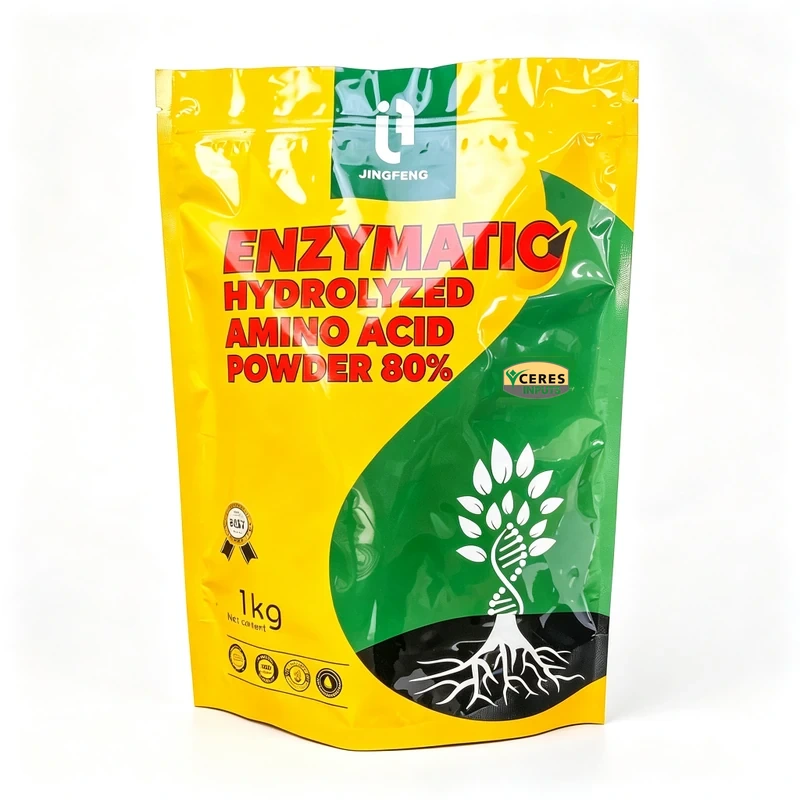
| 1 kg / 5 kg / 10 kg | Printed aluminium foil bag |
| 10 kg / 20 kg | Printed carton box |
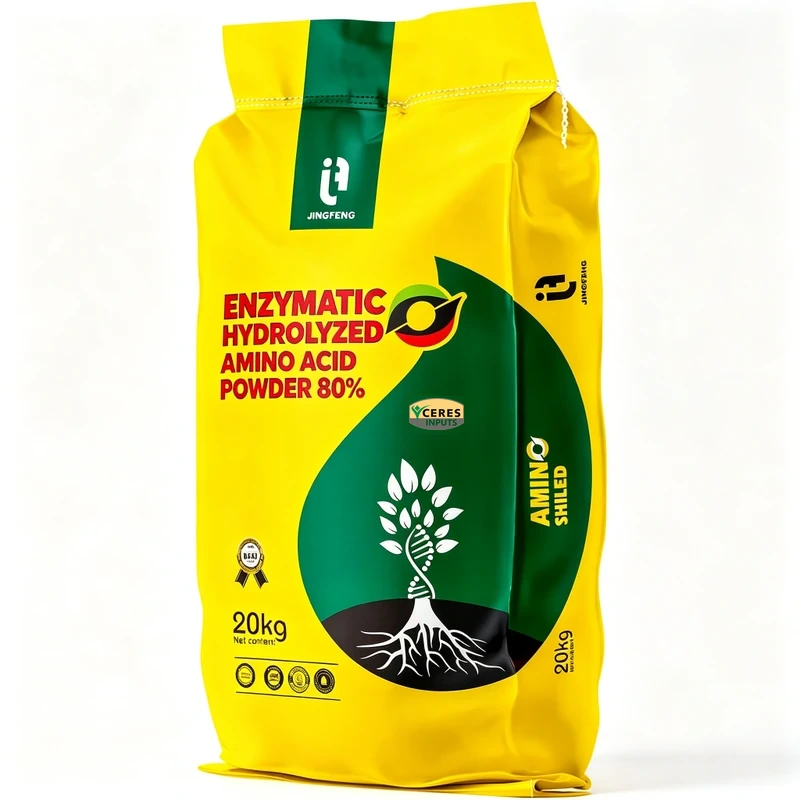
| 20 / 25 kg | Woven or paper bag with inner liner; colour-printed PP/PE bag with inner liner |
| 200 L drum / 1000 L IBC | For liquid grades; food-grade HDPE drum with tamper-evident closure |
| 1000 / 1100 kg | Jumbo bag with discharge spout |
Storage: Store in a cool, dry, well-ventilated place, away from direct sunlight and moisture. Stable for 24 months in the sealed original packaging; reseal opened bags. Liquid grades: store upright and frost-free.
Custom packaging, private-label printing and OEM specifications are available on request. Packaging photos are available in the product gallery.
Successful Cases
High-tech greenhouse cucumber, Netherlands
Integrated into the daily fertigation recipe at low ppm. A documented 15% increase in fruit number per plant and firmer fruit, attributed to better photosynthesis and assimilate partitioning.
Explore applications → Field referenceCommercial seed company, USA
Used in a proprietary hybrid corn seed coating. Treated seed emerged faster and more uniformly under cool soil conditions than the standard coating.
Explore applications → Field referencePremium wine estate, France
Foliar application during veraison. Laboratory analysis showed higher anthocyanin and polyphenol concentration in the fruit, contributing to greater wine complexity.
Explore applications → Field referenceLeafy greens vertical farm, Singapore
Added to the LED-optimized nutrient solution: growth cycle shortened by about 5% with higher dry matter content, lifting output per square metre.
Explore applications →Full case studies with crop data are published in our application sectors.
Frequently Asked Questions
What is the difference between enzymatic and hydrolyzed amino acids?
Hydrolysis uses acids or alkalis, which can destroy some amino acids and leave salts behind. Enzymatic processing uses specific enzymes for a cleaner, more controlled cut. It preserves a full amino acid spectrum, generates beneficial peptides and leaves fewer by-products — which is why enzymatic grades are the ones specified for high-value and certified programmes.
The free amino acid content is only 3–5%. Is that a weakness?
No, it is the design. The enzymatic cut is tuned to hold the amino acids as peptides (≥ 75% guaranteed) rather than breaking them all the way down to single molecules. Peptides are absorbed readily and additionally act as signalling molecules in the plant, so the effect is longer lasting. If your programme calls for a high free amino acid share, use one of our hydrolysed powders instead.
Why does the peptide content matter?
Peptides are short amino acid chains that behave as signalling molecules: they influence gene expression, stress response and growth regulation in ways free amino acids cannot. That gives a benefit that is both longer lasting and more systemic than a straight nutrient supply.
How should I adjust the dose compared with a 50% amino acid product?
Because the concentration is roughly doubled, the dose by weight comes down by about 40–50%. As a starting point: if you would use 1 g/L of a 50% product, start at 0.5–0.6 g/L of this one, then tune to the crop and the programme.
Can it be mixed with calcium or magnesium fertilisers?
Its pH of 5.0–8.0 and its low salt load make compatibility generally good. Because the concentration is high, still run a 100 mL jar test before mixing with any high-pH or high-calcium product — that remains the safe habit.
Is it suitable for organic farming?
Enzymatic processing is generally viewed favourably under organic standards as a natural biological process, but approval depends on the source material and on the certifier. Please check with your certification body and ask us for the input documentation you need.
What crops benefit most?
All crops respond, but the return is clearest on high-value crops (fruit, vegetables, flowers), on intensively managed systems (greenhouses, hydroponics, vertical farms) and wherever quality parameters such as sugar, colour or oil content set the price.
What is the shelf life?
The moisture ceiling of ≤ 5% and the stability of the enzymatic product give a long storage life; we guarantee 24 months in the sealed original packaging stored cool and dry. Reseal opened bags to keep moisture out.
How is it packed and what is the minimum order?
Standard pack is a 20 kg bag with inner liner, with 1 kg and 10 kg options for sampling. MOQ one pallet; 7–15 days ex-works. Private-label printing and custom blends are available on request.
Need a quotation or a sample?
Tell us your application, target market and packaging — we will come back with specification, price and lead time.
Request a Quote
 8618920222224