






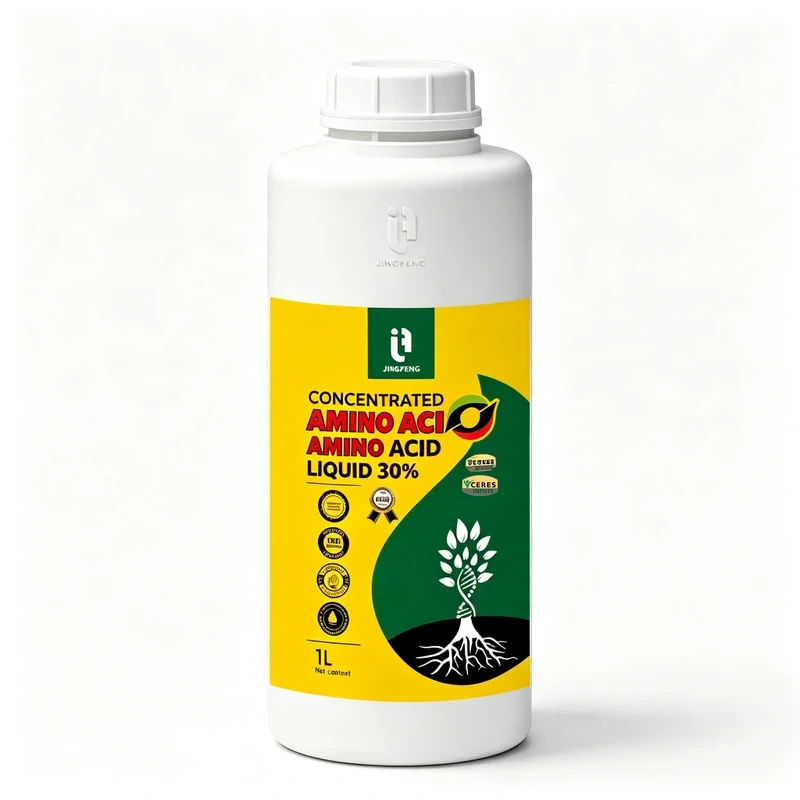
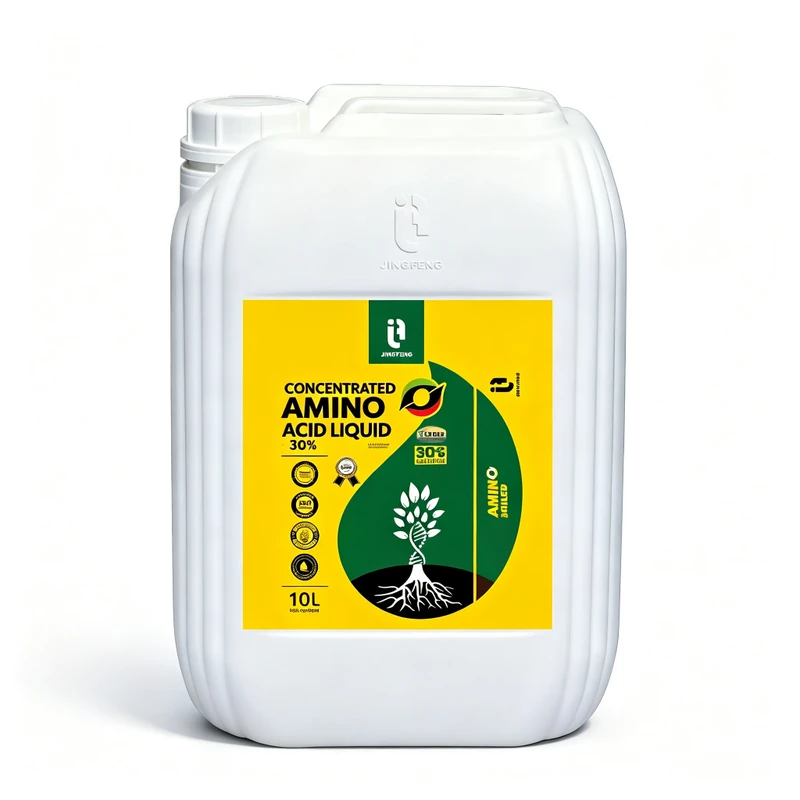
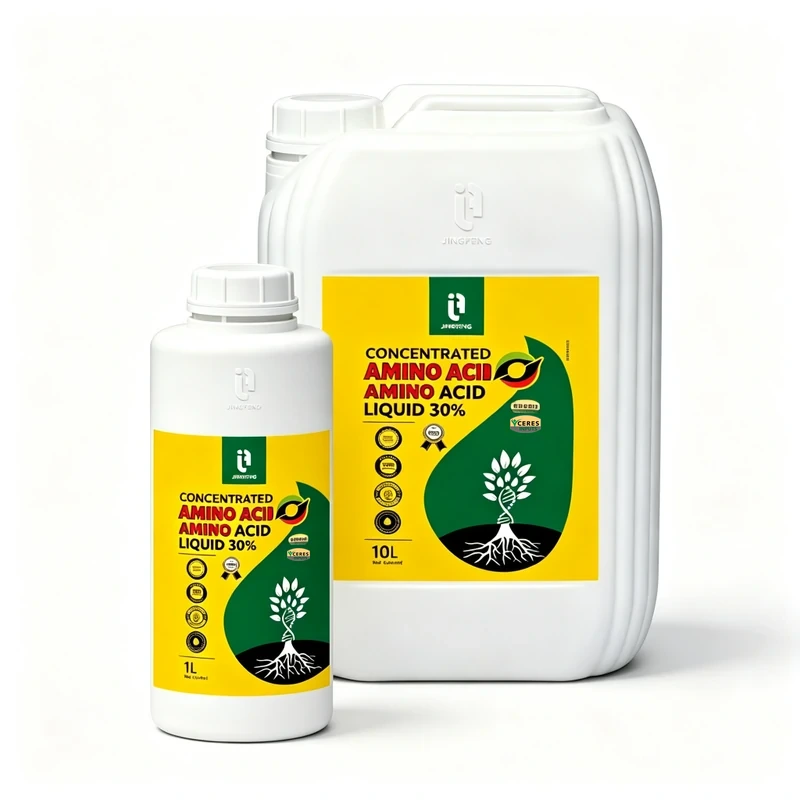
Concentrated Amino Acid Liquid 30%
High-Density Liquid — 300 g of Amino Acids in Every Litre
Every lot ships with a Certificate of Analysis stating tested total amino acids, free amino acids, total nitrogen and chloride.
Product Overview
Amino acids are the building blocks of proteins and, in free form, the most readily absorbed nitrogen source a plant or an animal can take up. JINGFENG’s amino acid range is produced from plant protein (soybean) or animal protein by acid or enzymatic hydrolysis, which breaks the protein chain down into free amino acids, short peptides and water-soluble nitrogen. The result is a 100% water-soluble input used as a foliar and fertigation biostimulant, a chelating agent for trace elements, and a feed-grade protein source.
Concentrated Amino Acid Liquid 30% is the volume-efficient grade of our liquid range. One litre carries a minimum of 300 g of total amino acids, so the volume you have to haul, store and meter per hectare is well below a dilute liquid — which is what decides the economics once a programme is measured in thousands of litres.
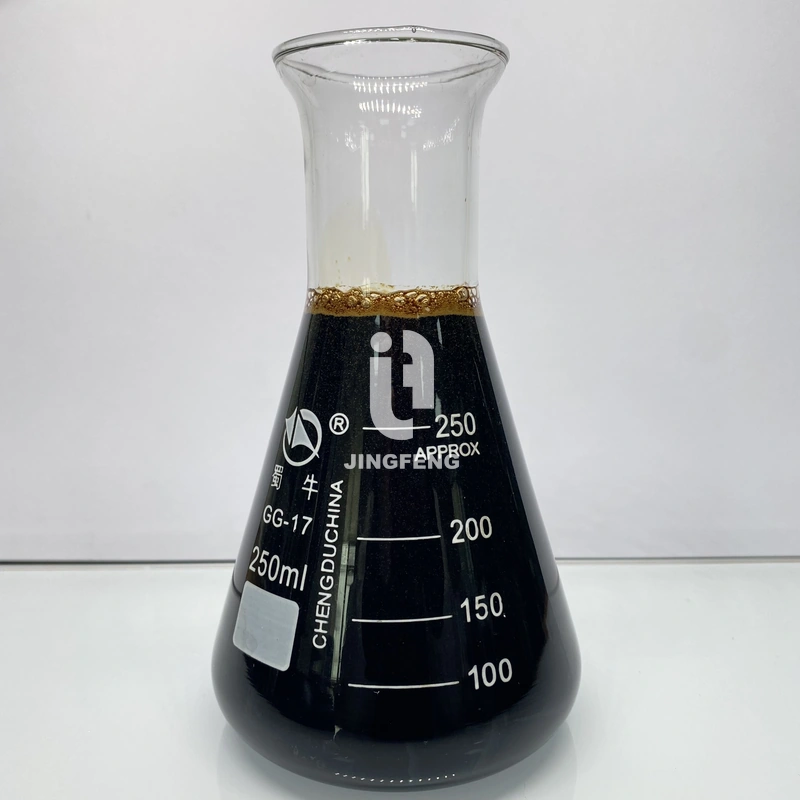
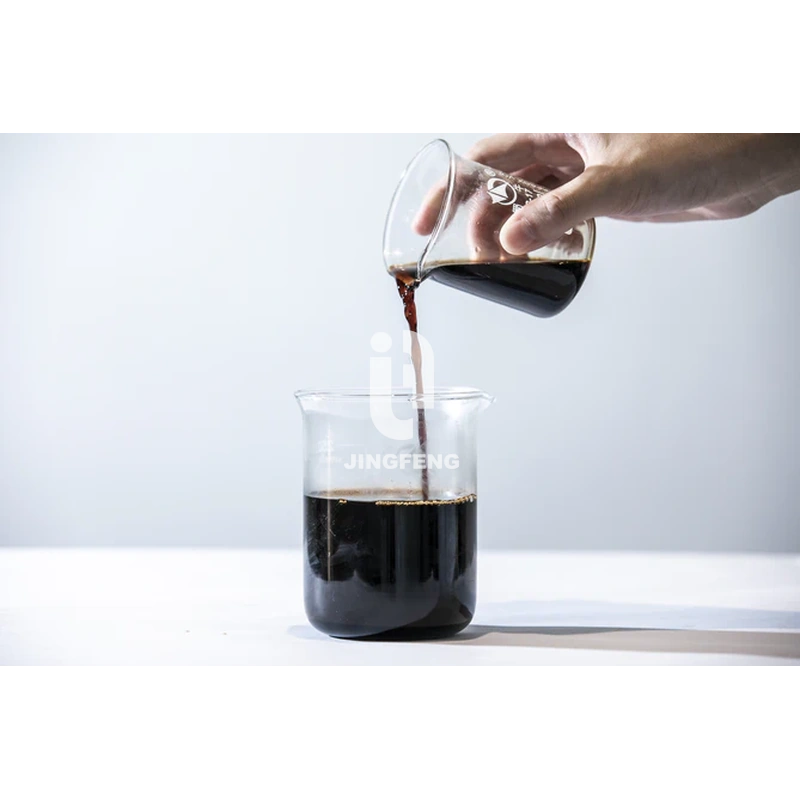
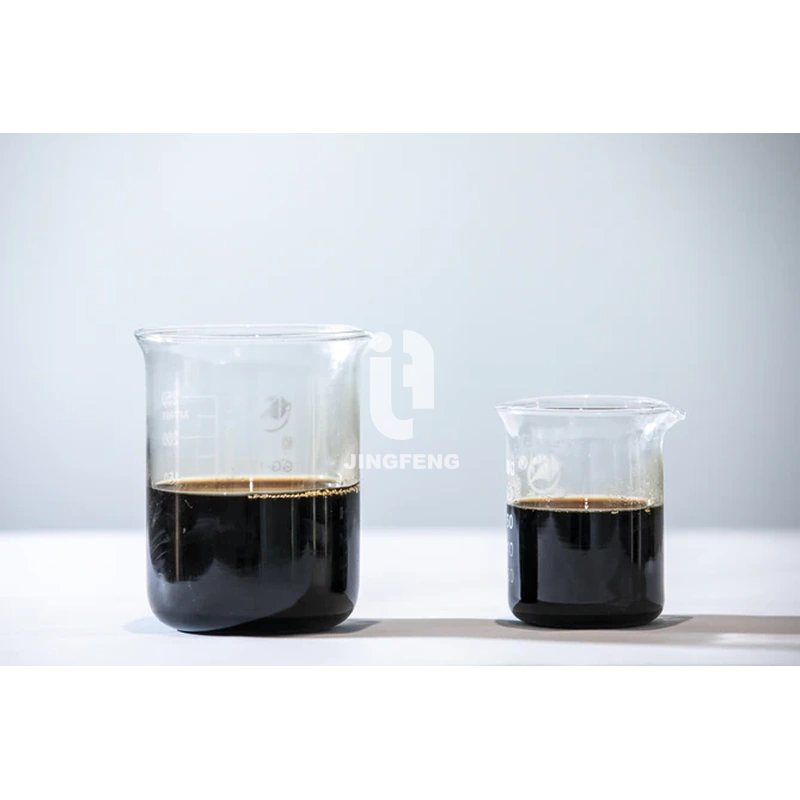
It is an acid hydrolysate, dark brown and dense at 1.20 – 1.22, carrying ≥ 7% total nitrogen alongside the amino acids and a full spectrum of eighteen free amino acids. Used on its own or blended with macro-, secondary- and micro-nutrients, it raises tolerance to cold, heat, drought and waterlogging.
One thing to check before you specify it: this grade is hydrolysed with hydrochloric acid and carries 9 – 11% chloride. That is normal and safe for cotton, grain and most field and vegetable crops at the recommended dilutions, but it is the wrong grade for strawberries, tobacco or grapes — use our salt-free 30% amino acid liquid there.
Key Benefits
≥ 300 g/L total amino acids
A concentrated grade: every litre carries at least 300 g of amino acids plus ≥ 7% total nitrogen, so less volume has to be hauled, stored and metered per hectare.
No dissolving step
Supplied ready to dilute, which saves a mixing stage in fertigation and spray programmes.
Metering accuracy
A uniform liquid is easy to dose precisely, batch after batch.
High load per litre
Concentrated grades carry a high amino acid load per litre, which keeps freight cost per unit of active down.
Mixes with most inputs
Compatible with common foliar fertilisers and, after a jar test, with many agrochemicals.
COA on every batch
Each lot ships with a Certificate of Analysis stating the tested total amino acids, free amino acids, total nitrogen, chloride and heavy metals against the stated Chinese industry standards.
Technical Specification
| Parameter | Specification | Test standard |
|---|---|---|
| Appearance | Dark brown liquid | Visual inspection |
| Total amino acid | ≥ 300 g/L | NY/T 1975-2010 |
| Total nitrogen | ≥ 7.0% | NY/T 1977-2010 |
| Organic nitrogen | ≥ 4.5% | NY/T 1977-2010 |
| Density | 1.20 – 1.22 | GB/T 20886.2-2021 |
| Chloride (Cl⁻) | 9.0 – 11.0% | NY/T 1117-2006 |
| pH | 4.0 – 6.0 | NY/T 1973-2021 |
| Lead (Pb) | ≤ 50 ppm | NY/T 1978-2022 |
| Cadmium (Cd) | ≤ 10 ppm | NY/T 1978-2022 |
| Mercury (Hg) | ≤ 5 ppm | NY/T 1978-2022 |
| Arsenic (As) | ≤ 10 ppm | NY/T 1978-2022 |
| Chromium (Cr) | ≤ 50 ppm | NY/T 1978-2022 |
Specification values are guaranteed minimums on a dry basis, taken from the batch Certificate of Analysis and tested against the stated Chinese industry standards. Every shipment travels with its own COA stating the tested values.
Need the full Certificate of Analysis, MSDS, or TDS for your formulation or tender file?
Request COA / MSDS / TDSForm & Solubility
Form: a concentrated liquid supplied in drums or IBCs, ready to dilute and meter without a dissolving step.
In water: miscible with water in any proportion, so it can be injected straight into a fertigation line or dosed into a spray tank.
Handling: store upright and frost-free. Rinse lines with clean water after use.
About the chloride. This grade is a hydrochloric-acid hydrolysate and carries 9–11% chloride. At the recommended dilutions that is safe for cotton, grain and most field and vegetable crops, but it is not the grade for strawberries, tobacco or grapes. For those crops, specify our salt-free 30% amino acid liquid.
Handling. The liquid thickens slightly as it stands — natural amino acid polymerisation, not spoilage. Stir it well before use; thickening does not reduce the nutrient content or the effect.
Typical amino acid composition — indicative analysis of the plant-source hydrolysate, shown for guidance and not a batch guarantee. Values are expressed in g/L. The binding specification is the total and free amino acid guarantee in the table above; each batch carries its own COA.
How the amino acid grades compare
| Grade | Form | Total amino acid | Free amino acid | Total nitrogen | Best for |
|---|---|---|---|---|---|
| Salt-Free Amino Acid Liquid 30% | Liquid | ≥ 300 g/L | — | ≥ 7.0% | Chloride-sensitive crops; foliar and drip |
| Concentrated Amino Acid Liquid 30% (this product) | Liquid | ≥ 300 g/L | — | ≥ 7.0% | Field crops and cotton; lowest volume per hectare |
| 40% Chlorine-Free Amino Acid Powder | Powder | ≥ 40.0% | ≥ 38.0% | — | Strawberry, tobacco and grape; chloride capped at 1% |
| 50% Hydrolyzed Amino Acid Powder | Powder | ≥ 45.0% | ≥ 40.0% | ≥ 15.0% | Cost-efficient foliar and fertigation over large areas |
| 50% Enzymatic Amino Acid Liquid | Liquid | ≥ 500 g/L | 20 – 30 g/L | — | Fertigation and foliar programmes, no dissolving step |
| 60% Hydrolyzed Amino Acid Powder | Powder | ≥ 60.0% | ≥ 55.0% | ≥ 12.0% | General-purpose foliar, drip and flushing |
| 70% Hydrolyzed Amino Acid Powder | Powder | ≥ 70.0% | ≥ 65.0% | ≥ 15.0% amino N | Fast free-amino response at flowering, fruit set and stress recovery |
| 80% Hydrolyzed Amino Acid Powder — Tank-Mix | Powder | ≥ 80.0% | ≥ 75.0% | ≥ 12.5% | Liquid NPK and trace-element compounding |
| 80% Amino Acid Powder — Standard | Powder | ≥ 80.0% | ≥ 75.0% | ≥ 12.5% | Feed premixes, dry blends, straight foliar and soil |
| 80% Enzymatic Amino Acid Powder | Powder | ≥ 80.0% | 3.0 – 5.0% | ≥ 15.0% | Peptide-driven programmes; seed treatment and high-value crops |
| 90% Hydrolyzed Amino Acid Powder | Powder | ≥ 90.0% | ≥ 85.0% | ≥ 15.0% organic N | Premium agriculture, feed and cosmetics |
| 90% Enzymatic Amino Acid Powder | Powder | ≥ 90.0% | ≥ 65.0% | ≥ 16.0% | Peptide-rich; organic and cosmetic specifications |
All grades are 100% water soluble and are hydrolysed from plant-source protein. Higher grades carry a larger free amino acid share, so less product is needed per hectare for the same response.
Applications & Dosage
For foliar and drip programmes on field crops, vegetables and fruit where volume efficiency matters. Typical rates are 10–15 L per hectare as a foliar spray and 20–25 L per hectare through drip, with two to three foliar applications per growth cycle.
| Application | How to use | Rate |
|---|---|---|
| Foliar spray | Spray in the morning or evening at the seedling, flowering and fruit-expansion stages. | 1:1000 – 1:1500 |
| Drip irrigation | Meter into the irrigation line at seedling and rapid growth, every 7–10 days. | 1:800 – 1:1200 |
| Flower and fruit retention | Apply once or twice at early flowering to support pollen viability and cut physiological drop. | 1:1000 – 1:1200 |
Packaging & Storage
| Pack size | Description |
|---|---|
| 1 kg / 5 kg / 10 kg | Printed aluminium foil bag |
| 10 kg / 20 kg | Printed carton box |
| 20 / 25 kg | Woven or paper bag with inner liner; colour-printed PP/PE bag with inner liner |
| 200 L drum / 1000 L IBC | For liquid grades; food-grade HDPE drum with tamper-evident closure |
| 1000 / 1100 kg | Jumbo bag with discharge spout |
Storage: Store in a cool, dry, well-ventilated place, away from direct sunlight and moisture. Stable for 24 months in the sealed original packaging; reseal opened bags. Liquid grades: store upright and frost-free.
Custom packaging, private-label printing and OEM specifications are available on request. Packaging photos are available in the product gallery.
Successful Cases
Cucumber greenhouse, Zhejiang (4 ha)
18% flower drop, thin foliage and uneven fruit size from an inconsistent nutrient supply. Foliar at 1:1200 at seedling and flowering with one drip application at 1:1000 at fruit set: flower drop down to 4%, foliage thick and dark green, 92% of fruit uniformly sized, and yield per hectare up 17% to 50 tons.
Explore applications → Field referenceTable grape plantation, Shandong (6 ha)
Slow colour transition (only 70% fully purple at harvest) and low sugar at 13.5 Brix. Foliar at 1:1300 at veraison plus one drip application at 1:900 ten days earlier: colour uniformity reached 94%, sugar rose to 15.2 Brix, and market acceptance increased by 25%.
Explore applications →Full case studies with crop data are published in our application sectors.
Frequently Asked Questions
How is this different from a non-concentrated amino acid liquid?
Density. At 300 g/L or more of total amino acids, this grade carries a higher load per litre than the 100–200 g/L typical of non-concentrated liquids, so you use 20–30% less volume per hectare. That is what makes it the economical choice for large-scale programmes.
Does the 9–11% chloride content affect crops?
At the recommended dilutions, no — that level is within the safe range for most crops, particularly field crops such as cotton and grain. It does cause chloride toxicity on sensitive crops, so for strawberries, tobacco and grapes choose our salt-free 30% liquid instead.
Is it suitable for organic farming?
It is made from natural raw materials with no synthetic additives. Whether it is accepted in your programme depends on the certifier and on the chloride level they allow, so confirm with your certification body.
Can I use it on young seedlings?
Yes. Use the weaker end of the foliar range (around 1:1500) and test a small area first — it lifts seedling vigour without causing stress or burn.
When is the best time to apply it for flower and fruit retention?
Once or twice during early flowering, at 1:1000 to 1:1200 as a foliar spray. That is when it does the most for pollen viability and for reducing physiological flower drop.
Can I mix it with pesticides?
It is compatible with most neutral and weakly acidic pesticides. Avoid strongly alkaline products above pH 8, and test compatibility by mixing 100 mL of diluted liquid with the pesticide — use it only if nothing precipitates.
What if the liquid thickens over time?
That is normal — natural amino acid polymerisation. Stir it vigorously with water before use; thickening does not reduce the nutrient content or the effectiveness.
Do you offer samples, and what is the minimum order?
A 1 L sample is available; you cover the express cost and we dispatch within two working days with a short trial guide. Bulk MOQ is 500 L, with 5–8% volume discounts above 5000 L.
How is it packed and how long does it keep?
Supplied in 200 L drums and 1000 L IBCs, with 1 L, 5 L and 20 L packs for trials. Shelf life is 24 months from production when stored cool, dry and sealed; store upright and frost-free, and rinse lines with clean water after use.
Need a quotation or a sample?
Tell us your application, target market and packaging — we will come back with specification, price and lead time.
Request a Quote
 8618920222224