






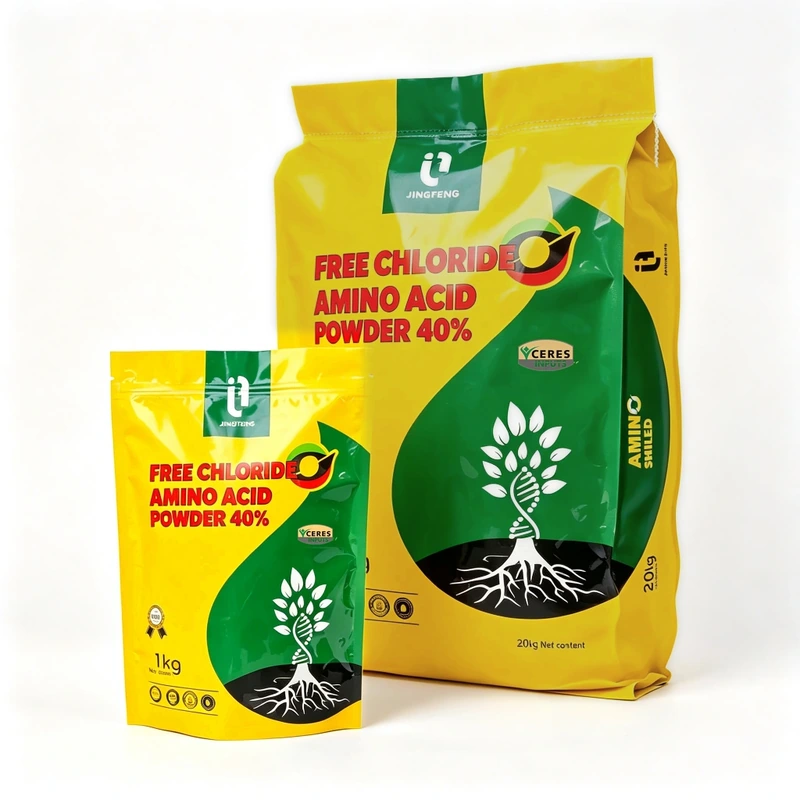
40% Chlorine-Free Amino Acid Powder
Built for Chloride-Sensitive Crops — Chloride Capped at 1%
Every lot ships with a Certificate of Analysis stating tested total amino acids, free amino acids, total nitrogen and chloride.
Product Overview
Amino acids are the building blocks of proteins and, in free form, the most readily absorbed nitrogen source a plant or an animal can take up. JINGFENG’s amino acid range is produced from plant protein (soybean) or animal protein by acid or enzymatic hydrolysis, which breaks the protein chain down into free amino acids, short peptides and water-soluble nitrogen. The result is a 100% water-soluble input used as a foliar and fertigation biostimulant, a chelating agent for trace elements, and a feed-grade protein source.
40% Chlorine-Free Amino Acid Powder is built for one job: supplying amino acids to chloride-sensitive crops without the chloride. Chloride is capped at ≤ 1.00% and production lots run a long way below that ceiling, which is low enough for strawberries, tobacco, grapes and other crops where chloride shows up as leaf scorch, poor leaf quality or lost sugar.
Against that it still delivers ≥ 40% total amino acids with ≥ 38% in the free form — the fraction that is absorbed within roughly a day, which is what matters when a crop is coming out of stress or moving through flowering.
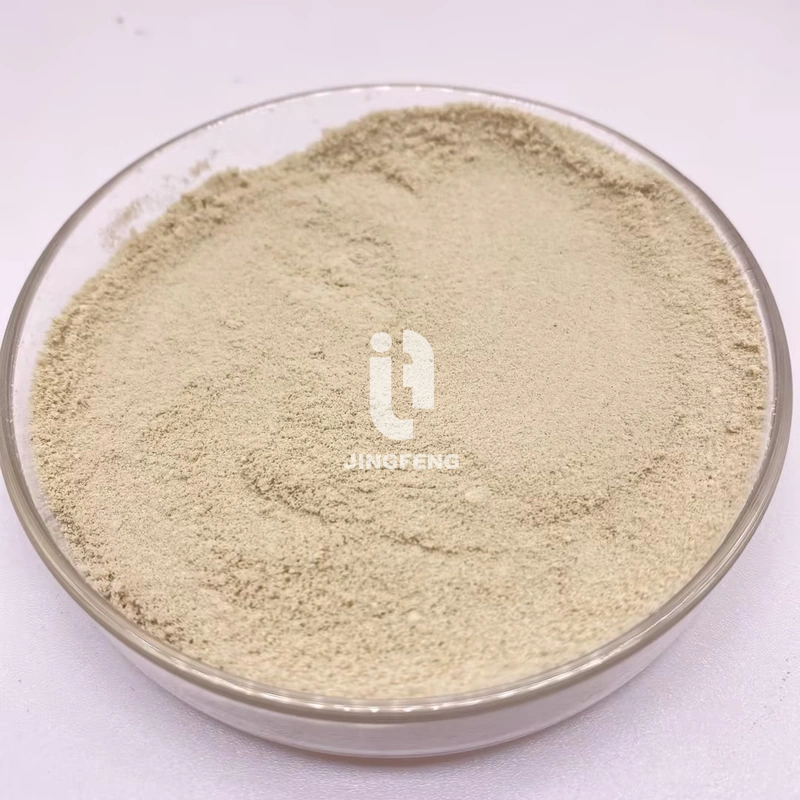
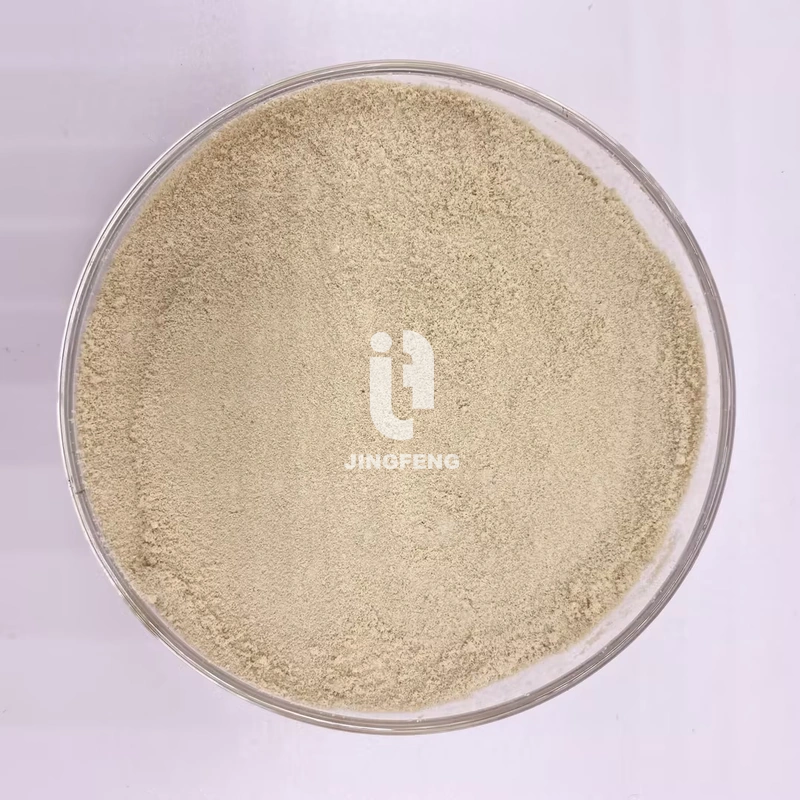
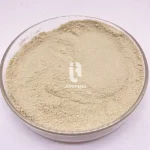
It is a fully water-soluble yellow powder, safe from seedling emergence through to harvest, and it goes through sprayers and drip lines without blocking them.
Key Benefits
≥ 40.0% total amino acids
A guaranteed floor of ≥ 40.0%, with ≥ 38.0% in the free form that plants and animals absorb directly.
Dissolves completely
100% water soluble with no residue, so it can go straight into the spray tank or through a drip line.
High free amino acid share
A large part of the load is in the free form, which plants and animals absorb without further breakdown.
Low chloride option
Low-chloride grades avoid salt burn on chloride-sensitive crops and keep the salt load down in feed rations.
Blend-friendly
A free-flowing powder that disperses evenly into NPK, organic fertilizer and feed premixes, even at low inclusion rates.
COA on every batch
Each lot ships with a Certificate of Analysis stating the tested total amino acids, total nitrogen, chloride, pH and density for that batch.
Technical Specification
| Parameter | Specification | Test standard |
|---|---|---|
| Appearance | Yellow powder | Visual inspection |
| Total amino acid | ≥ 40.0% | NY/T 1975-2010 |
| Free amino acid | ≥ 38.0% | NY/T 1975-2010 |
| Chloride (Cl⁻) | ≤ 1.00% | NY/T 1117-2006 |
| pH | 4.0 – 6.0 | NY/T 1973-2021 |
Specification values are guaranteed minimums on a dry basis, taken from the batch Certificate of Analysis and tested against the stated Chinese industry standards. Every shipment travels with its own COA stating the tested values.
Need the full Certificate of Analysis, MSDS, or TDS for your formulation or tender file?
Request COA / MSDS / TDSForm & Solubility
Form: fine, free-flowing powder with low dust, easy to weigh out by the bag and to blend into dry mixes.
In water: 100% water soluble. It wets out quickly and dissolves cleanly under light agitation, leaving no residue to block filters, spray nozzles or drip lines.
Handling: use standard dust protection when handling bulk. Reseal opened bags to keep moisture out.
Why chloride is capped. Chloride comes with most acid hydrolysis routes, and on strawberries, tobacco, grapes and many protected crops it shows up as leaf scorch, poor leaf quality and lost sugar. Holding the ceiling at 1% means the product can be used right through the cycle on those crops, from seedling to harvest.
Mixing. Stir for one to two minutes to be sure the powder has fully dissolved before bringing in anything else. Avoid strongly alkaline products above pH 8, and run a 100 mL jar test before the first tank mix.
How the amino acid grades compare
| Grade | Form | Total amino acid | Free amino acid | Total nitrogen | Best for |
|---|---|---|---|---|---|
| Salt-Free Amino Acid Liquid 30% | Liquid | ≥ 300 g/L | — | ≥ 7.0% | Chloride-sensitive crops; foliar and drip |
| Concentrated Amino Acid Liquid 30% | Liquid | ≥ 300 g/L | — | ≥ 7.0% | Field crops and cotton; lowest volume per hectare |
| 40% Chlorine-Free Amino Acid Powder (this product) | Powder | ≥ 40.0% | ≥ 38.0% | — | Strawberry, tobacco and grape; chloride capped at 1% |
| 50% Hydrolyzed Amino Acid Powder | Powder | ≥ 45.0% | ≥ 40.0% | ≥ 15.0% | Cost-efficient foliar and fertigation over large areas |
| 50% Enzymatic Amino Acid Liquid | Liquid | ≥ 500 g/L | 20 – 30 g/L | — | Fertigation and foliar programmes, no dissolving step |
| 60% Hydrolyzed Amino Acid Powder | Powder | ≥ 60.0% | ≥ 55.0% | ≥ 12.0% | General-purpose foliar, drip and flushing |
| 70% Hydrolyzed Amino Acid Powder | Powder | ≥ 70.0% | ≥ 65.0% | ≥ 15.0% amino N | Fast free-amino response at flowering, fruit set and stress recovery |
| 80% Hydrolyzed Amino Acid Powder — Tank-Mix | Powder | ≥ 80.0% | ≥ 75.0% | ≥ 12.5% | Liquid NPK and trace-element compounding |
| 80% Amino Acid Powder — Standard | Powder | ≥ 80.0% | ≥ 75.0% | ≥ 12.5% | Feed premixes, dry blends, straight foliar and soil |
| 80% Enzymatic Amino Acid Powder | Powder | ≥ 80.0% | 3.0 – 5.0% | ≥ 15.0% | Peptide-driven programmes; seed treatment and high-value crops |
| 90% Hydrolyzed Amino Acid Powder | Powder | ≥ 90.0% | ≥ 85.0% | ≥ 15.0% organic N | Premium agriculture, feed and cosmetics |
| 90% Enzymatic Amino Acid Powder | Powder | ≥ 90.0% | ≥ 65.0% | ≥ 16.0% | Peptide-rich; organic and cosmetic specifications |
All grades are 100% water soluble and are hydrolysed from plant-source protein. Higher grades carry a larger free amino acid share, so less product is needed per hectare for the same response.
Applications & Dosage
For chloride-sensitive and protected crops, and for programmes that run from seedling through to harvest. Typical rates are 4–5 kg per hectare for foliar applications and 8–10 kg per hectare through drip, with two to three foliar applications per growth cycle.
| Application | How to use | Rate |
|---|---|---|
| Foliar spray | Spray in the morning or evening at the seedling, flowering and fruit-expansion stages. | 1:1500 – 1:2000 |
| Drip irrigation | Apply through the drip system at seedling and rapid growth, every 7–10 days. | 1:1000 – 1:1500 |
| Young seedlings | Use the weaker end of the range on young plants and test a small area first. | 1:2000 |
| Chloride-sensitive crops | Strawberry, tobacco, grape and similar crops where chloride damage is a known risk. | 1:1500 – 1:2000 |
Packaging & Storage
| Pack size | Description |
|---|---|
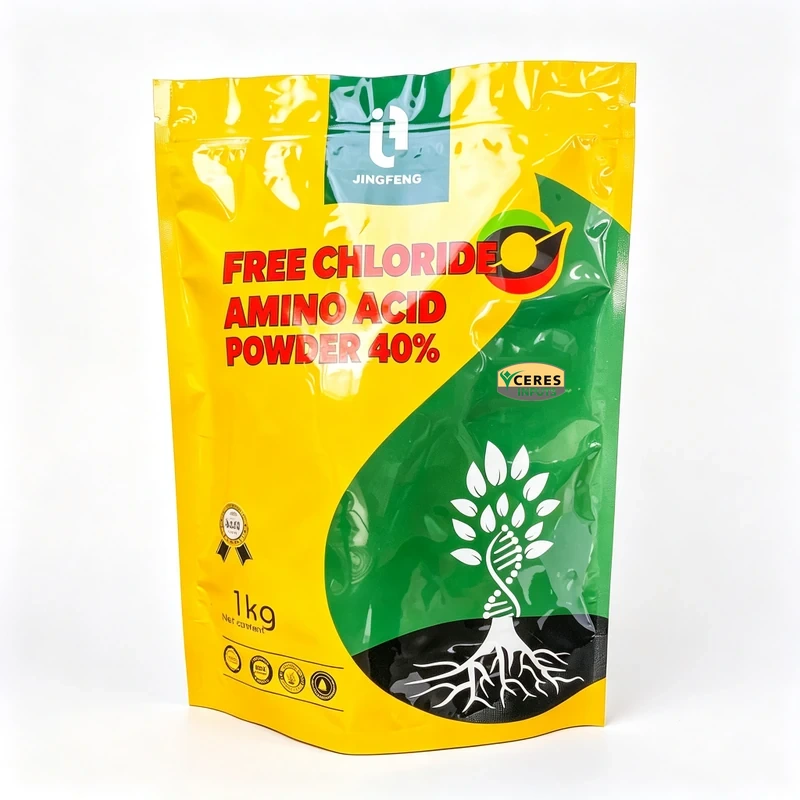
| 1 kg / 5 kg / 10 kg | Printed aluminium foil bag |
| 10 kg / 20 kg | Printed carton box |
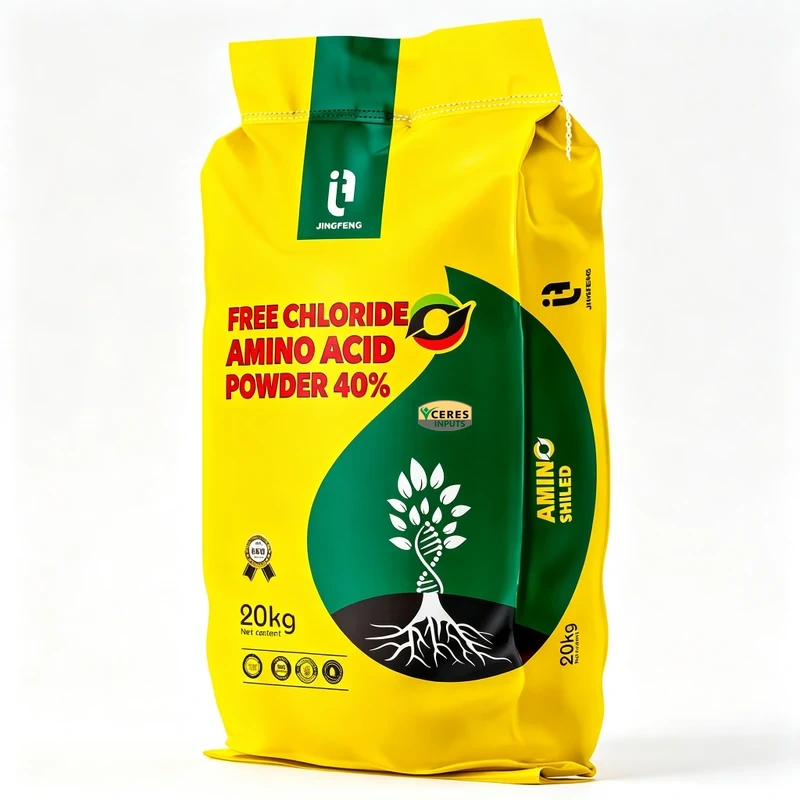
| 20 / 25 kg | Woven or paper bag with inner liner; colour-printed PP/PE bag with inner liner |
| 200 L drum / 1000 L IBC | For liquid grades; food-grade HDPE drum with tamper-evident closure |
| 1000 / 1100 kg | Jumbo bag with discharge spout |
Storage: Store in a cool, dry, well-ventilated place, away from direct sunlight and moisture. Stable for 24 months in the sealed original packaging; reseal opened bags. Liquid grades: store upright and frost-free.
Custom packaging, private-label printing and OEM specifications are available on request. Packaging photos are available in the product gallery.
Successful Cases
Strawberry plantation, Shandong (5 ha)
Earlier high-chlorine inputs had caused 18% leaf burn and 22% flower drop. Foliar at 1:1800 at bud break and flowering, with one drip application at 1:1200 at young fruit: leaf burn eliminated, flower drop down to 5%, fruit averaging 21 g at 11.8 Brix, and yield per hectare up 20%.
Explore applications → Field referenceTobacco field, Yunnan (6 ha)
Chloride build-up had left pale leaf with nicotine below 1.8%, failing premium grade. Drip at 1:1000 at seedling and rapid growth plus one foliar at 1:1500 at leaf expansion: leaf turned uniform dark green, nicotine reached 2.1%, yield up 17% and unit income up 25% on the higher grade.
Explore applications →Full case studies with crop data are published in our application sectors.
Frequently Asked Questions
Why is it called chlorine-free when it still contains chloride?
No acid hydrolysis route is literally chloride-free; ‘chlorine-free’ here means the chloride is capped at ≤ 1.00% and production lots run well below that ceiling. At that level there is no chloride-related damage even on sensitive crops.
How does it differ from a regular amino acid powder?
Two things: the chloride ceiling is ≤ 1.00% instead of the several percent typical of a standard hydrolysate, and the free amino acid share is guaranteed at ≥ 38%. Between them you get a product that is safe on sensitive crops and fast to absorb.
Which crops benefit most from the low chloride?
Strawberries, tobacco, grapes, potatoes and most protected crops — anything where chloride shows up as leaf scorch, poor leaf quality, lost sugar or lost storage life.
Is it suitable for organic farming?
It is made from natural raw materials with no synthetic additives and is accepted in organic programmes in many markets. Rules differ by certifier, so confirm with your certification body and ask us for the input list.
Can I use it on young seedlings?
Yes. Use the weaker end of the foliar range (around 1:2000) and test a small area first. The formula is mild enough to lift seedling vigour without burning.
Why does a high free amino acid share matter?
Free amino acids are small molecules that need no breakdown, so a crop takes them up within about a day. That is the difference it makes during stress recovery and at key stages such as flowering and fruit set.
Can I mix it with pesticides?
It works with most neutral and weakly acidic pesticides. Avoid strongly alkaline products above pH 8, and test compatibility with 100 mL of diluted solution before committing the whole tank.
What if the powder cakes from moisture?
Break the cake up and dissolve it in water — caking does not reduce the nutrient content or the absorption efficiency. Reseal opened bags and store them cool and dry.
How is it packed and what is the minimum order?
Standard pack is a 20 kg bag with inner liner, with 1 kg and 10 kg options for sampling. Bulk MOQ is 1000 kg, with 5–10% volume discounts above 10 tons. A 1 kg sample is available — you cover the express cost.
Need a quotation or a sample?
Tell us your application, target market and packaging — we will come back with specification, price and lead time.
Request a Quote
 8618920222224