






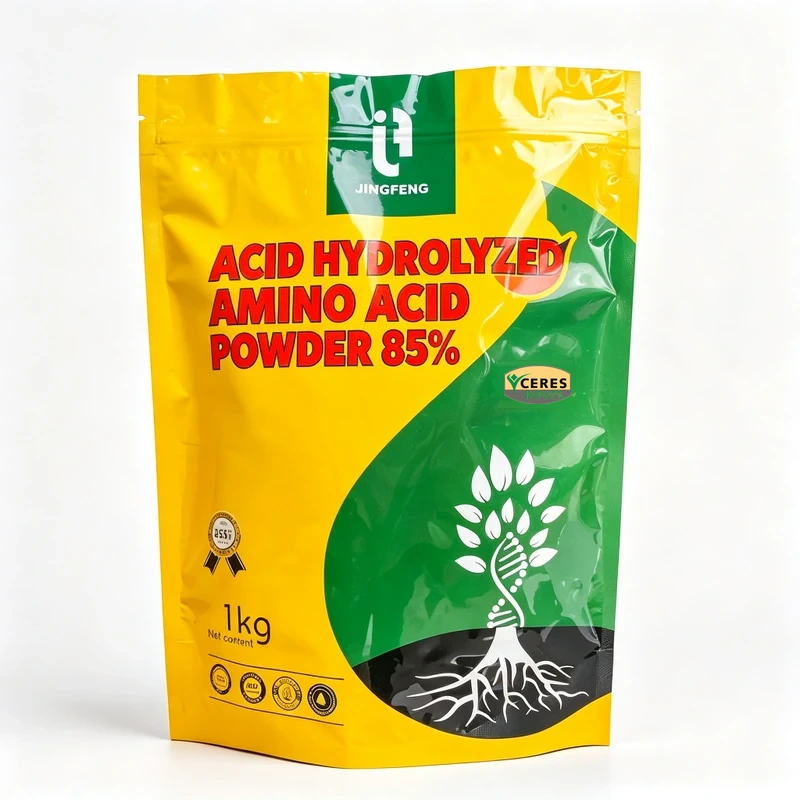
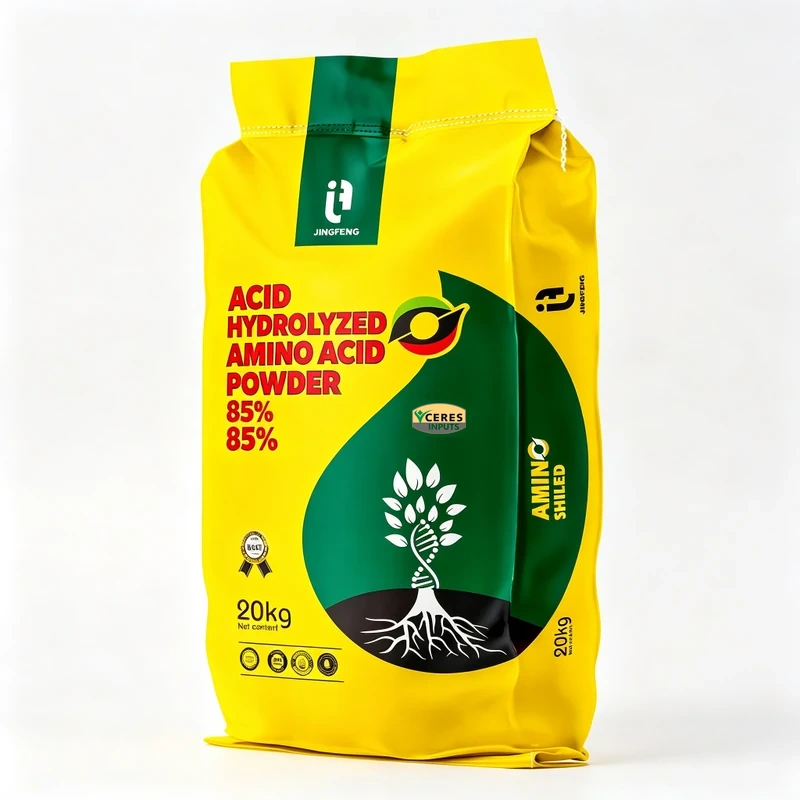
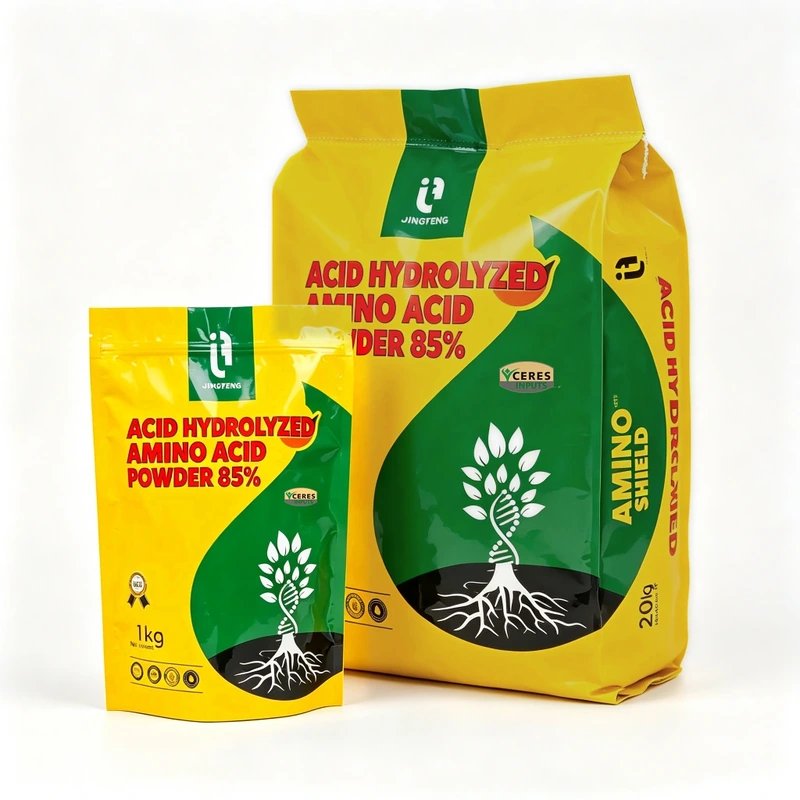
85% Hydrolyzed Amino Acid Powder
85% Total Amino Acids — One Grade for Crops, Feed and Cosmetics
Every lot ships with a Certificate of Analysis stating tested total amino acids, free amino acids, total nitrogen and chloride.
Product Overview
Amino acids are the building blocks of proteins and, in free form, the most readily absorbed nitrogen source a plant or an animal can take up. JINGFENG’s amino acid range is produced from plant protein (soybean) or animal protein by acid or enzymatic hydrolysis, which breaks the protein chain down into free amino acids, short peptides and water-soluble nitrogen. The result is a 100% water-soluble input used as a foliar and fertigation biostimulant, a chelating agent for trace elements, and a feed-grade protein source.
85% Hydrolyzed Amino Acid Powder is the top of the JINGFENG amino acid range. Where the workhorse grades sit between 30% and 80%, this one is specified at ≥ 85.0% total amino acids with ≥ 80.0% in the free form — the fraction a plant or an animal can take up directly, without further breakdown. Total nitrogen is ≥ 13.0% and chloride is held to ≤ 3.0%.
The profile is dominated by glycine and alanine, with glutamic acid and threonine close behind. That combination is what makes it unusual: glycine and alanine are among the smallest amino acids and the most mobile in the plant, while the same two are strong water-binding agents — the reason this grade is also specified for cosmetic formulations. The powder is 100% water soluble at a mildly acidic pH of 4 to 6, so it dissolves clear and does not cloud a tank mix or a finished serum.
Because the purity is high, the inclusion rates are low. In the field the rates run 30–50% below a standard amino acid product; in feed and cosmetic work it is dosed at fractions of a percent.
Key Benefits
≥ 85.0% total amino acids
This is the highest-purity grade in the range: at least 85% total amino acids with at least 80% in the free form, ≥ 13% total nitrogen and chloride held under 3%. It is the grade that goes into premium foliar programmes, high-end feed rations and cosmetic formulations alike.
Dissolves completely
100% water soluble with no residue, so it can go straight into the spray tank or through a drip line.
High free amino acid share
A large part of the load is in the free form, which plants and animals absorb without further breakdown.
Low chloride option
Low-chloride grades avoid salt burn on chloride-sensitive crops and keep the salt load down in feed rations.
Blend-friendly
A free-flowing powder that disperses evenly into NPK, organic fertilizer and feed premixes, even at low inclusion rates.
COA on every batch
Each lot ships with a Certificate of Analysis stating the tested total amino acids, free amino acids, total nitrogen, chloride and heavy metals against the stated Chinese industry standards.
Technical Specification
| Parameter | Specification | Test standard |
|---|---|---|
| Appearance | Light yellow powder | Visual inspection |
| Total amino acid | ≥ 85.0% | NY/T 1975-2010 |
| Free amino acid | ≥ 80.0% | NY/T 1975-2010 |
| Total nitrogen | ≥ 13.0% | NY/T 1977-2010 |
| Chloride (Cl⁻) | ≤ 3.0% | NY/T 1117-2006 |
| Water solubility | 100% | NY/T 1973-2021 |
| pH | 4.0 – 6.0 | NY/T 1973-2021 |
| Lead (Pb) | ≤ 50 ppm | NY/T 1978-2022 |
| Cadmium (Cd) | ≤ 10 ppm | NY/T 1978-2022 |
| Mercury (Hg) | ≤ 5 ppm | NY/T 1978-2022 |
| Arsenic (As) | ≤ 10 ppm | NY/T 1978-2022 |
| Chromium (Cr) | ≤ 50 ppm | NY/T 1978-2022 |
Specification values are guaranteed minimums on a dry basis, taken from the batch Certificate of Analysis and tested against the stated Chinese industry standards. Every shipment travels with its own COA stating the tested values.
Need the full Certificate of Analysis, MSDS, or TDS for your formulation or tender file?
Request COA / MSDS / TDSForm & Solubility
Form: fine, free-flowing powder with low dust, easy to weigh out by the bag and to blend into dry mixes.
In water: 100% water soluble. It wets out quickly and dissolves cleanly under light agitation, leaving no residue to block filters, spray nozzles or drip lines.
Handling: use standard dust protection when handling bulk. Reseal opened bags to keep moisture out.
Why glycine and alanine lead. These are two of the smallest amino acids, and in a hydrolysate that means two things in practice. They move fastest through the leaf and the root, which is what you want from a foliar biostimulant applied against a stress window. And they are the strongest natural humectants in the profile, which is why cosmetic formulators specify this grade for hydration products.
Using it. Dissolve the powder in water before adding anything else — at this purity it wets out quickly, but adding it to a concentrated salt solution first will slow it down. In a tank mix, keep the solution mildly acidic; above pH 8 the free amino acids start to salt out.
Typical amino acid composition — indicative analysis of the plant-source hydrolysate, shown for guidance and not a batch guarantee. Values are expressed in %. The binding specification is the total and free amino acid guarantee in the table above; each batch carries its own COA.
How the amino acid grades compare
| Grade | Form | Total amino acid | Free amino acid | Total nitrogen | Best for |
|---|---|---|---|---|---|
| 85% Hydrolyzed Amino Acid Powder (this product) | Powder | ≥ 85.0% | ≥ 80.0% | ≥ 13.0% | Highest-purity grade; also used in feed and cosmetic formulations |
| Amino Acid Chelated Trace Elements Liquid | Liquid | ≥ 200 g/L | — | ≥ 12.0% | Trace element correction plus nitrogen; no dissolving step |
| Amino Acid Chelated Trace Elements Powder 15% | Powder | ≥ 25.0% free | ≥ 25.0% | — | Six chelated trace elements on a free amino acid base |
| Salt-Free Amino Acid Liquid 30% | Liquid | ≥ 300 g/L | — | ≥ 7.0% | Chloride-sensitive crops; foliar and drip |
| Concentrated Amino Acid Liquid 30% | Liquid | ≥ 300 g/L | — | ≥ 7.0% | Field crops and cotton; lowest volume per hectare |
| 30% Hydrolyzed Amino Acid Powder | Powder | ≥ 30.0% | — | ≥ 7.0% | Field-scale foliar, fertigation and liquid fertiliser base |
| Transparent Amino Acid Liquid 30% | Liquid | ≥ 300 g/L | — | ≥ 7.0% | Low-chloride liquid for strawberry, tobacco and grape |
| 30% Amino Acid Round Granule | Granule | ≥ 30.0% | — | ≥ 7.0% | Machine spreading, NPK blending and seedling substrate |
| 40% Chlorine-Free Amino Acid Powder | Powder | ≥ 40.0% | ≥ 38.0% | — | Strawberry, tobacco and grape; chloride capped at 1% |
| Amino Acid Chelated Calcium and Magnesium Liquid | Liquid | ≥ 400 g/L | ≥ 200 g/L | — | Blossom-end rot, fruit cracking and magnesium chlorosis |
| 45% Hydrolyzed Amino Acid Powder | Powder | ≥ 45.0% | ≥ 40.0% | ≥ 17.0% | High-nitrogen grade; liquid formulations and hydroponics |
| 50% Hydrolyzed Amino Acid Powder | Powder | ≥ 45.0% | ≥ 40.0% | ≥ 15.0% | Cost-efficient foliar and fertigation over large areas |
| Amino Oligosaccharide Peptide Liquid | Liquid | ≥ 500 g/L | ≥ 200 g/L | — | Plant activation; flower and fruit drop and disease pressure |
| 50% Enzymatic Amino Acid Liquid | Liquid | ≥ 500 g/L | 20 – 30 g/L | — | Fertigation and foliar programmes, no dissolving step |
| 60% Hydrolyzed Amino Acid Powder | Powder | ≥ 60.0% | ≥ 55.0% | ≥ 12.0% | General-purpose foliar, drip and flushing |
| 70% Hydrolyzed Amino Acid Powder | Powder | ≥ 70.0% | ≥ 65.0% | ≥ 15.0% amino N | Fast free-amino response at flowering, fruit set and stress recovery |
| 80% Hydrolyzed Amino Acid Powder — Tank-Mix | Powder | ≥ 80.0% | ≥ 75.0% | ≥ 12.5% | Liquid NPK and trace-element compounding |
| 80% Amino Acid Powder — Standard | Powder | ≥ 80.0% | ≥ 75.0% | ≥ 12.5% | Feed premixes, dry blends, straight foliar and soil |
| 80% Enzymatic Amino Acid Powder | Powder | ≥ 80.0% | 3.0 – 5.0% | ≥ 15.0% | Peptide-driven programmes; seed treatment and high-value crops |
| 90% Hydrolyzed Amino Acid Powder | Powder | ≥ 90.0% | ≥ 85.0% | ≥ 15.0% organic N | Premium agriculture, feed and cosmetics |
| 90% Enzymatic Amino Acid Powder | Powder | ≥ 90.0% | ≥ 65.0% | ≥ 16.0% | Peptide-rich; organic and cosmetic specifications |
All grades are 100% water soluble and are hydrolysed from plant- or animal-source protein. Higher grades carry a larger free amino acid share, so less product is needed per hectare for the same response.
Applications & Dosage
One specification for three industries. In agriculture it is a premium foliar and fertigation biostimulant, used at 30–50% lower rates than a standard amino acid product because of the purity. In feed it is a digestible protein enhancer for poultry and livestock. In cosmetics it is a natural humectant and conditioning agent with a skin-friendly pH.
| Application | How to use | Rate |
|---|---|---|
| Foliar spray | Spray the leaf evenly, front and back, in the morning or the evening. Two to three applications per cycle at seedling, flowering and fruiting. | 1:1000 – 1:1500 · 0.67–1.0 g/L |
| Drip irrigation | Dissolve fully, then meter into the line. Three to four applications per growth cycle. | 1:2000 – 1:3000 · 0.33–0.5 g/L |
| Animal feed | Blend evenly into the basal ration and feed continuously; adjust for growth stage. | 0.1% – 0.5% of total feed |
| Cosmetic and personal care | Dissolve in deionized water first, then blend into the aqueous phase. Patch and stability test before scale-up. | 0.3% – 2.5% of the formulation |
Packaging & Storage
| Pack size | Description |
|---|---|
| 1 kg / 5 kg / 10 kg | Printed aluminium foil bag |
| 10 kg / 20 kg | Printed carton box |
| 20 / 25 kg | Woven or paper bag with inner liner; colour-printed PP/PE bag with inner liner |
| 200 L drum / 1000 L IBC | For liquid grades; food-grade HDPE drum with tamper-evident closure |
| 1000 / 1100 kg | Jumbo bag with discharge spout |
Storage: Store in a cool, dry, well-ventilated place, away from direct sunlight and moisture. Stable for 24 months in the sealed original packaging; reseal opened bags. Liquid grades: store upright and frost-free.
Custom packaging, private-label printing and OEM specifications are available on request. Packaging photos are available in the product gallery.
Successful Cases
Grape cultivation, Yunnan (40 acres)
Uneven ripening and poor drought resistance through the dry season, with leaf wilting across the block. Foliar at 1:1200 during berry expansion, every 8 days, three applications, plus two drip applications at 1:2500. Ripening uniformity improved 30%, sugar rose 1.5 °Brix, leaf wilting dropped 70%, yield rose 14% and marketable fruit rate rose 22%.
Explore applications → Field referencePremium berry farm, Chile
Blueberries coming off undersized with uneven colour and inconsistent sweetness at harvest. Foliar programme through fruit set and berry fill. Larger berry size, more uniform colour and higher Brix at picking.
Explore applications → Field referenceLayer breeding farm, Shandong (15,000 birds)
Poor eggshell quality with a 6% egg breakage rate cutting into margins. 0.25% of the product added to the basal feed, continuously for 10 weeks. Breakage fell from 6% to 1.2%, eggshell thickness rose 18%, egg production rose 7%, and the flock handled seasonal temperature swings better.
Explore applications → Field referenceNight cream formulation, Guangzhou
A local brand wanted better moisture retention from its night cream for dry-skin consumers. 1.5% of the powder replaced 30% of the traditional humectants. 24-hour moisture retention improved 40% on a skin moisture meter, with softer skin reported after two weeks and a 25% rise in repeat purchases for the line.
Explore applications →Full case studies with crop data are published in our application sectors.
Frequently Asked Questions
How can one product serve agriculture, feed and cosmetics?
The core value is the same in all three: highly bioavailable, pure amino acids. They are the building blocks of plant proteins and enzymes, of animal tissue, and of the skin’s own natural moisturising factor. What changes is only the dose and the formulation around it.
Why is it specified for cosmetics?
Glycine and alanine — the two largest fractions in the profile — are excellent water-binding agents, and the pH of 4.8 sits close to the skin’s own acid mantle. It is natural-origin, light in colour and fully soluble, so it works in clear serums and gels as well as creams.
What inclusion rate should a formulator start from?
In a finished cosmetic formulation a common starting point is 0.5 to 5%, depending on whether it is a rinse-off or a leave-on product. Run stability and patch tests before committing to a production batch.
For feed, does it replace synthetic amino acids?
It gives a broad-spectrum amino acid boost plus functional benefits, so it can reduce the need for some synthetics — but it works best alongside them, used to balance the overall amino acid profile and support gut health rather than as a straight swap.
How do the field rates compare with a standard amino acid product?
Because it carries 85% total amino acids, rates run roughly 30 to 50% lower. For a foliar spray start at 0.3 to 1 g per litre; for drip, 0.33 to 0.5 g per litre.
Is it safe to apply the raw powder to skin?
No — the raw powder is a manufacturing ingredient. It should be formulated into finished cosmetic products under good manufacturing practice. End users should not apply it directly.
Is it certified for organic or natural cosmetic standards?
Its natural origin makes it a strong candidate for COSMOS, NATRUE and similar standards. Final certification always depends on the complete formulation and on the certifying body, so confirm with them directly.
What is the shelf life?
More than 24 months stored cool and dry in sealed packaging. For cosmetic use, follow the standard preservative protocol for the finished product.
Need a quotation or a sample?
Tell us your application, target market and packaging — we will come back with specification, price and lead time.
Request a Quote
 8618920222224